


 Go Back
Share
From Data to Dialogue: A Conversation with Rajni Shekhawat
By CSF Editorial Team and Rajni Shekhawat
Mar 24, 2026
This interview with Rajni Shekhawat, CBEO, Jodhpur, highlights a pilot across 54 government schools, demonstrating the value of structured learning assessments. It shows how simple, comparable data enables meaningful discussions on school performance and drives classroom improvements, with a focus on identifying and addressing learning gaps across grades and subjects through regular reviews. The piece also points to scaling the initiative across all 15 blocks in Jodhpur, strengthening accountability for learning across the system.
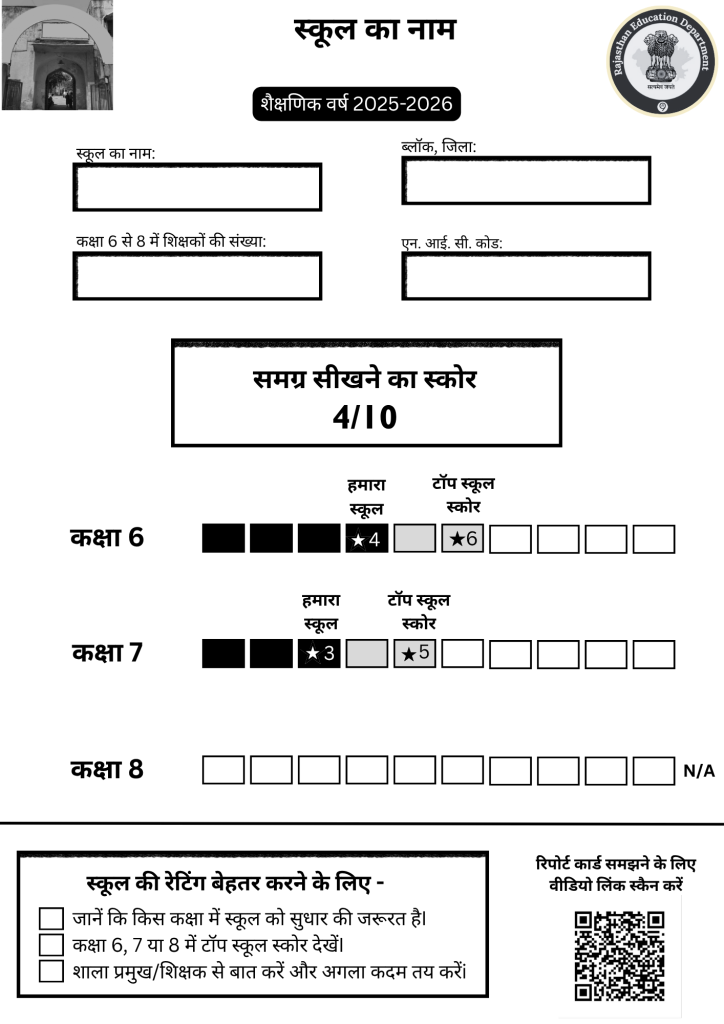
Since September 2025, an experiment on measuring & disclosing school quality data has been underway in Jodhpur. A competency-based assessment was conducted across Grades 6 to 8 in 54 English-medium Mahatma Gandhi Government Schools in the Jodhpur city block. Subjective responses were graded using an AI-enabled tool developed by EdOptimise and the results were translated into school report cards that were shared not only with principals and teachers but also with parents.
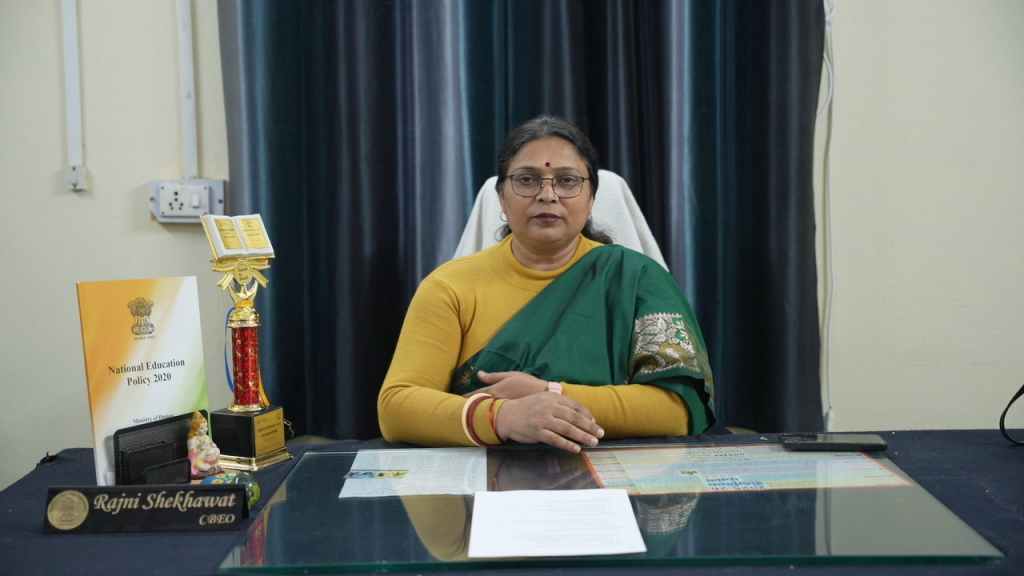
In this article, we speak with Rajni Shekhawat, Chief Block Education Officer of the Jodhpur city block, who played a key role in implementing this pilot on the ground. Her experience offers insight into what happens when school-level learning outcomes are shared more openly with schools and communities.
Q1. Before this pilot began, what was the biggest challenge in understanding how schools in your block were performing?
The biggest challenge was the lack of uniformity. Every school conducted assessments in its own way and even within a school teachers sometimes followed different approaches. Because of this, the data that existed was scattered and difficult to compare across schools.
Schools did have marks from internal exams, but those marks did not always give a clear picture of where students were actually struggling. In many cases, we observed that even when marks were available, they did not clearly show the specific learning gaps across subjects or grades.
Another important gap was on the parent side. Parents could see their own child’s report card, but they had very little information about how the school itself was performing. They could not easily see the overall learning levels in the school or how their school compared with others nearby. Without that information, it was difficult for parents to engage schools in meaningful conversations about the quality of education their children were receiving or make informed decisions about where to enrol their children.
Q2. How did the competency-based assessment change this picture?
The biggest change we saw was that all 54 schools were assessed using the same set of questions and evaluated through a standardised process. The responses were graded using an AI-enabled tool, which ensured that the evaluation was consistent across schools and reduced the possibility of human error or bias in grading. This allowed learning outcomes to be measured on the same scale across all schools in the block.
Because the questions were mapped to specific grade-level competencies, the results gave a clearer picture of where students were doing well and where they needed support. For the first time, principals and teachers could see patterns in learning across grades and subjects. In several schools, we noticed that once the data was presented in this way, discussions quickly shifted toward identifying specific learning gaps.
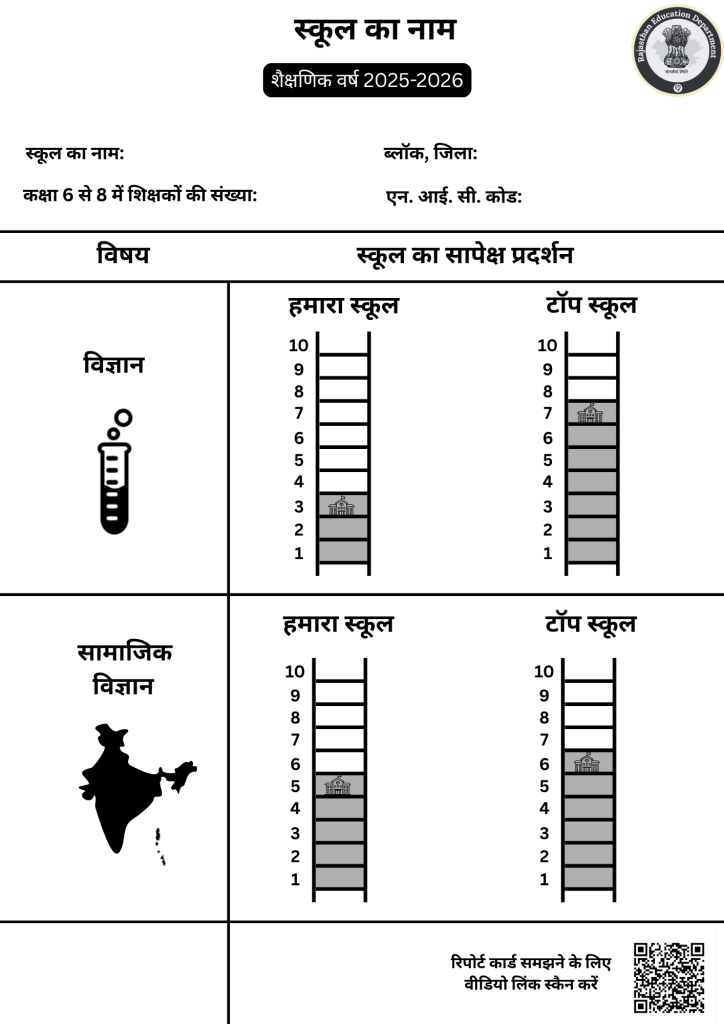
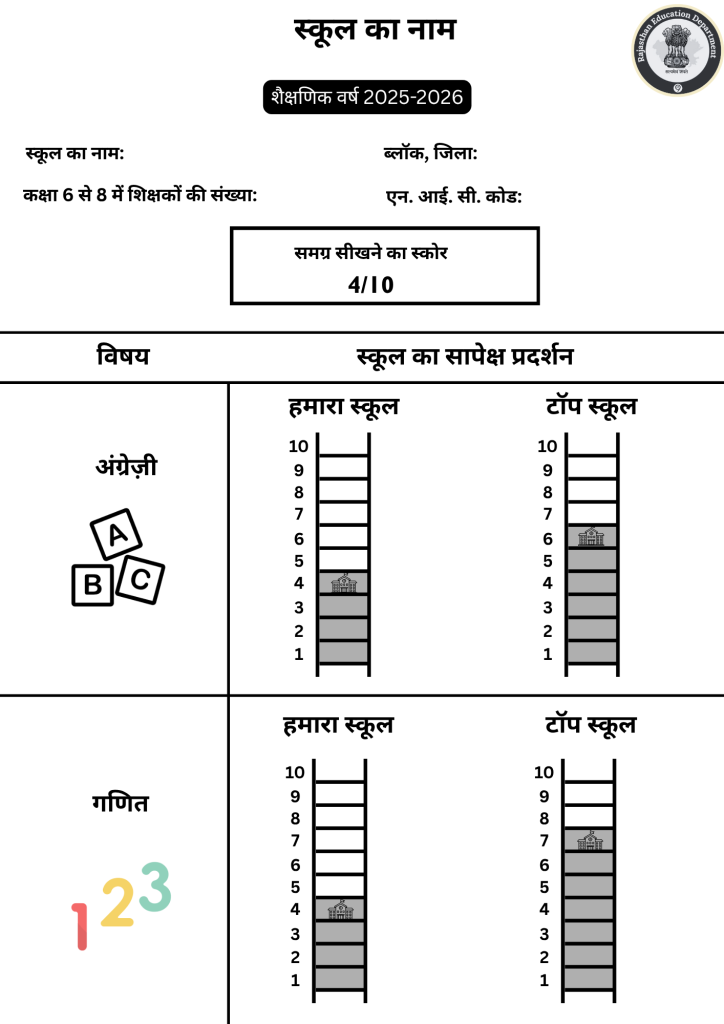
The school report cards have helped make this information easier to use for all of us. Principals could see how their school was performing across grades and subjects and teachers could identify areas where students needed additional support.
We also organised workshops with principals and teachers to help them understand how to read and interpret the report cards. Many school leaders mentioned that this was the first time they had access to comparable learning data about how their school was performing relative to others in the block. These discussions helped schools clearly understand the purpose of the exercise and how the data could be used to improve teaching and learning.


Q3. The pilot also involved sharing school report cards with parents. What difference did this make in how parents engaged with schools?
Earlier, parents mostly saw only their own child’s report card. While this helped them understand their child’s performance, they had very little information about how the school itself was doing in terms of learning outcomes. Without that visibility, it was difficult for parents to ask questions about the overall quality of education or understand how their school was performing relative to others in the neighbourhood.
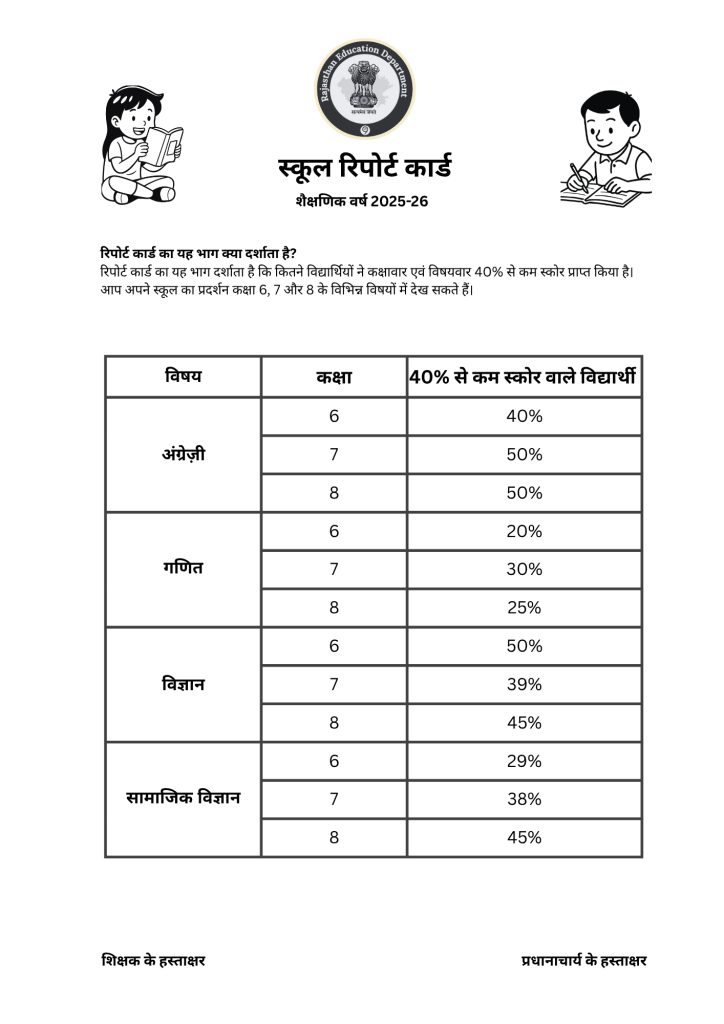
Sharing the school report cards has helped address this gap. For the first time, parents received simple information about how their child’s school was performing.
These report cards were shared during parent–teacher meetings and through parent WhatsApp groups so that the information could reach every family. We also took time to explain how to read the report card so that parents could clearly understand what the results meant.
Once this information became available, we began to notice a change in engagement. Parents started asking questions and trying to understand why certain scores were lower or where improvements were needed. Actually, when parents begin asking these kinds of questions, it creates an important sense of accountability around learning outcomes within the school system.
Q4. Now that both schools and communities have access to this information, what changes do you hope to see in how learning gaps are addressed?
Now that schools have access to this information, we hope to see conversations about improvement becoming more specific and evidence-based.
Earlier, discussions about school quality were often quite general. Schools would talk about improving performance, but they did not always have clear data showing where the learning gaps were.
With the report cards, principals can now see patterns in learning outcomes across grades and subjects. In several schools, we observed that this helped principals and teachers start more focused discussions about how to address those gaps.
For example, if written English is weak across several classes, the school leadership can begin discussing what might be causing that gap and what changes could help address it. These could include school-level steps such as increasing English instructional time or classroom-level changes like giving students more opportunities to practise writing.
Teachers can also use class-level data to identify which students need additional support and in which competencies.
Since this information is also shared with parents, these conversations are no longer limited to schools alone. Parents can see how their child’s school is performing overall and how it compares with other schools in the block. This allows them to ask more informed questions about learning outcomes and how the school plans to address those gaps.
When everyone is looking at the same information, it becomes much easier to focus on practical solutions. Over time, this kind of evidence-based reflection can help schools and communities work together to improve student learning outcomes.
Q5. This started with 54 schools. Where does the initiative go from here?
The next step is to expand the initiative beyond our block. Plans are already underway to scale the assessments across all 15 blocks in the Jodhpur district, covering more than 1,400 schools across Grades 6 to 9.
What the Jodhpur pilot has shown is that sharing learning outcomes in a simple and understandable format can have a powerful impact. Over the course of the pilot, we observed that when this information was shared widely, conversations across schools and communities began to shift toward learning outcomes. Parents begin asking more questions about learning, schools begin reflecting more closely on their performance and the overall focus of the system gradually shifts toward improving learning outcomes. Over time, we believe this creates a stronger sense of accountability for learning across the system.
Keywords
Authored by

CSF Editorial Team

Rajni Shekhawat
Chief Block Education Officer, Jodhpur city block
Share this on