


 Go Back
Share
Five Years On: NIPUN Bharat and India’s Path to Viksit Bharat
By CSF Editorial Team and Shri. Sanjay Kumar
Jun 23, 2026
As India marks five years of the NIPUN Bharat Mission, this article reflects on its progress within the broader vision of the National Education Policy (NEP) 2020 and Viksit Bharat 2047. While recognising significant gains in foundational literacy and numeracy (FLN), it also examines persistent challenges across the education system. Shri Sanjay Kumar, IAS, Secretary, Department of School Education & Literacy, Ministry of Education, Government of India, highlights key lessons from the mission's first five years and underscores the need to keep foundational learning at the heart of India's education agenda through sustained collaboration among government, communities, civil society and institutions as NIPUN Bharat enters its next phase.
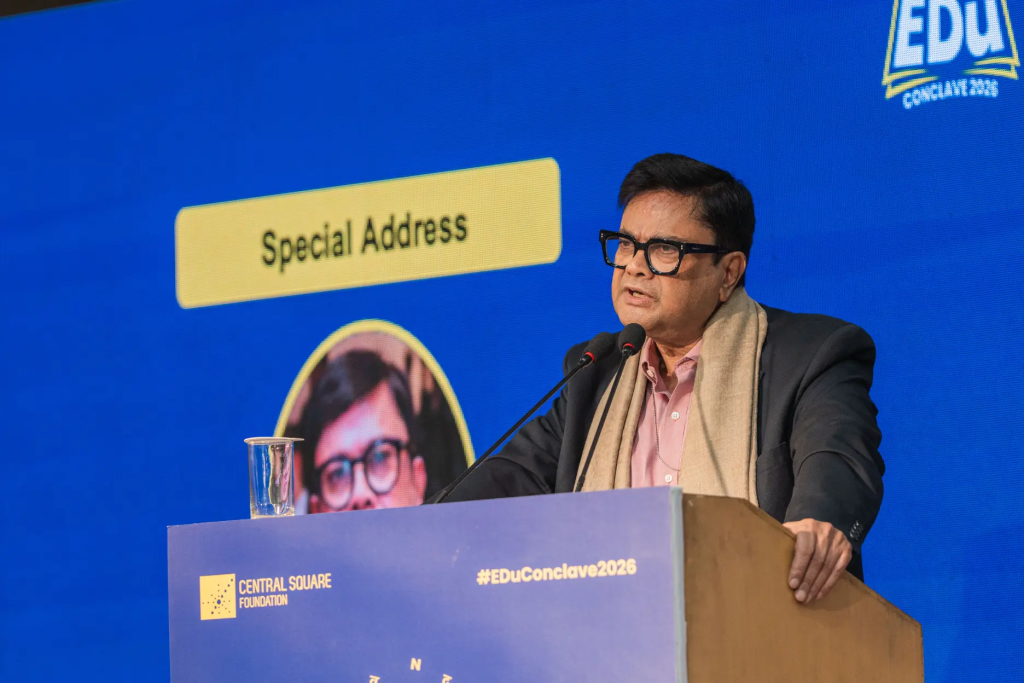
Editor’s Note: This article is an edited excerpt from the special address delivered by Shri Sanjay Kumar, IAS, Secretary, Department of School Education and Literacy, Ministry of Education, Government of India, at the CSF EduConclave 2026, on 24 April 2026.
Reflecting on how far we have come since the inception of the NIPUN Bharat Mission in July 2021, backed by the National Education Policy (NEP) 2020, is a humbling reminder of the power of perseverance and dedication and how it truly bears fruit if done right. As we complete 5 years of NIPUN, I already feel hopeful for an even bigger transformational journey for the education landscape in India in the coming years.
For us, in the Ministry of Education,the guiding document in this effort remains the National Education Policy 2020 and one sentence in the Policy defines this legacy moment ,”The rest of this Policy will become relevant for our students only if this most basic learning requirement (i.e. reading, writing, arithmetic at the foundational level) is first achieved’
A great amount of work is being done in Indian education today and in all of it the role of the civil society organisations remains important. Civil society is a very important stakeholder, because education is a community exercise. It is not the role of the government alone; while they are key players, this is a systems approach. Sarkar, Samaaj, Bazaar and Sanstha must all come together if we are to make a meaningful difference for each and every citizen.
The writing on the wall
Let me begin with a digression. We all know how important it is to invest in education and yet education is sometimes looked upon as a revenue expenditure. Most of us are aware of James Heckman’s work. Every additional year of schooling adds 0.37% to Gross Domestic Product (GDP); every additional year raises individual productivity by 10%; and a one standard-deviation increase in learning outcomes is associated with a 15% increase in an individual’s earnings. The writing is on the wall: we need to invest and do it adequately, in education.
In the Department of School Education and Literacy, work is divided among several bureau heads and one quickly realises how artificial such division is; there is no way to divide into parts something that is an absolute whole. Foundational Literacy and Numeracy (FLN) is certainly a part of education, but it has to be seen in its entirety, as one whole system. I would include even higher education in that whole, but for now, let’s restrict to K-12, from pre-primary to Class 12.
The children we cannot yet see
What are the challenges before us? It is not that we never had pre-primary classes before, but they were not part of policy as such. NEP 2020 has made them a part of policy and changed the pedagogical structure of schooling to 5+3+3+4. The first stage of five years is itself a subset of the 0-to-8 band, but our focus is on 3 to 8; three years of pre-primary.
Where are these children? They are in four places:
- The majority are in Anganwadi centres.
- A second group is in schools that have pre-primary classes.
- A third is in standalone pre-primary schools run by the private sector.
- And some may be nowhere at all; they may simply be at home.
When we look at the data, we get the Anganwadi numbers and the school numbers, but we do not get the numbers for pre-primary classes run by the private sector and we do not know how many children are at home. In other words, we can locate about 75% of these children; the remaining 25% we cannot. How do we find the other 25%? One idea we are considering is to give a UDISE code to private pre-primary classes, so that at least we are able to track them. That is challenge number one.
Challenge number two concerns teaching at the right level, in an age-appropriate way. We deal with two numbers, Gross Enrolment Ratio and Net Enrolment Ratio and in an ideal situation the two should converge, though in practice a fair gap remains. NEP 2020 says a child should be six years of age on entering Grade 1. But children arrive in Grade 1 from very different pathways. How do we ensure a common starting point regardless of the path taken? We are alive to this. We have introduced a three-month Vidya Pravesh programme so that, whatever the pathway, children are brought to the same level. We have the play-based Jadui Pitara for pre-primary classes and a digital equivalent, the e-Jadui Pitara. There is Aadharshila, brought in by the Ministry of Women and Child Development. We are also encouraging states to use locally contextual toys, with the simple condition that each toy be mapped to a learning outcome.
Measuring is an extremely important part of our system and we need to devise the systems to do it well.
From access to completion
If you trace the evolution of education policy since the 1980s, you find that the focus has been overwhelmingly on elementary education; Operation Blackboard, the District Primary Education Programme, the 86th Constitutional Amendment, the Right to Education Act of 2009 and the Sarva Shiksha Abhiyan. To some extent, secondary education was left behind and the data shows it. Of every 100 children in Grade 1, about 76 appear for the Grade 10 examination, but only 60 reach Grade 12. This is the challenge before us, against NEP’s goal of a 100% Gross Enrolment Ratio for secondary education by 2030. Every child should be in school; no child should be out of school; and a child who enters school should be able to climb all the way to Grade 12.
The Gross Enrolment Ratio for elementary education today is approximately 93%, which means we still do not have about 7% of children in our schools and we are trying to bring them back. The Periodic Labour Force Survey (PLFS) data for the 14-to-18 age group is more sobering: nearly 20 million or two crore children in this group are out of school. Up to age 14 almost everyone is covered, but after 14 children begin dropping out and boys are dropping out faster than girls; at the secondary level the dropout rate for boys is higher. When this cohort was asked why they are out of school, 76% pointed to the same reasons, which was to supplement household income, primarily in the case of boys and to perform domestic chores in the case of girls. Only 1% said they were out of school because the school was too far away. How far a school should be is itself a question worth examining.
The drift to private schools and the language question
School education was part of the State List until 1976, when it was moved to the Concurrent List; by then much of the system had already taken shape in the states. Of the 14.71 lakh schools in the country today, about 10.5 lakh are government schools and roughly 3.72 lakh are private, with the remainder government-aided. Some 49% of children are in government schools, 10% in government-aided schools and 41% in privately managed schools. A common cause of concern, one we keep raising with colleagues in the states, is the steady transition from public to private. Every year, when we finalise the UDISE+ data, we find we are losing numbers. That is a challenge: perhaps we are not getting something right in government schools and children are leaving us.
Part of the answer lies in language. NEP 2020 says a child should begin learning in the mother tongue. When you have developed proficiency in the language you are comfortable with the language you speak at home, your cognitive intake is also better; only then do you pick up a second language, which could be English. From age six we follow a three-language formula, which earlier ran from ages six to eight but has now been extended up to Grade 10.
The question I leave behind is this: do we want to learn English as a medium of instruction, or as a subject? I personally feel that even learning English as a subject, you can develop a fair amount of proficiency in it; I am sure there are many in this hall who learned English as a subject. I recall my own father, who learned the English alphabet only in Class 6. Comparing notes much later, I found that I perhaps spoke English a little more fluently than he did, but in writing I do not think I bettered him; he wrote equally good English, if not better. This is a question we need to think about, because it affects education across the country and it partly explains why so many parents, out of a sense of aspiration, feel encouraged to send their children to private schools.
Are our children actually learning?
We must teach well – that is the basic question before us. Children are in school, but are they learning? Some time ago I watched a video of Jeffrey Sachs, in which he was asked how one decides whether a society is changing for the better. He offered four things to look for. Are children learning well? Are they learning to think innovatively? If they are learning well and thinking innovatively, are new technologies being created? And is household income going up, since that is the basis of investment? It struck me that three of those four begin in our schools and this is where it begins. We must begin well.
I am very happy that the NIPUN Bharat Mission, our flagship mission for FLN, was launched in 2021 by the Honourable Prime Minister and it has done reasonably well; honestly that is an understatement, because I am quite excited about it. For the first time, learning outcomes for Grade 3 have shown not an incremental but a substantial jump, with the PARAKH Rashtriya Sarvekshan 2024 results supported by the ASER reports. The numbers came in at 64 and 60 for language and Mathematics. The encouraging finding is that children in rural areas have done better than those in urban areas at Grade 3 and government students have done better than private-school students.
But when you look at Grade 6 and 9, the elation evaporates. At Grade 6 there is a substantial reduction; the urban schools and private schools pull ahead. At Grade 9 the learning outcomes fall further still. Language is falling, but Mathematics is falling drastically and I feel that if we cannot enthuse a student in Mathematics, the fault lies squarely on our own shoulders. Mathematics is so interesting and yet it brings on a peculiar mental block. Improving our learning outcomes is the challenge.
A window that will not open again
Consider the structure of our schools. We run more than ten types; Grades 1 to 5, 1 to 8, 1 to 10, 1 to 12, 6 to 12, 8 to 12, even schools running only Grade 11 and 12. But the largest numbers of children are in just two types: Grades 1 to 12 and Grades 6 to 12. Parents and students prefer integrated schools and there is a lesson in that. Looking at completion rates to Grade 12 across states and union territories, Chandigarh has the best figures; not a perfect comparison, given it is a small city union territory (UT), but it does well because more than 70% of its schools are integrated, running from Grade 1 to Class 12. A child who enters such a school in Grade 1 reaches Grade 12 with hardly any dropout. We have been telling states to create more integrated schools and upgrade the infrastructure within them.
A related idea I have been discussing is this: we have about 1,27,000 secondary and higher secondary schools in the country. If we upgrade these to run like a Kendriya Vidyalaya, from pre-primary to Grade 12, with two sections each and an average enrolment of a thousand, these schools alone could hold more than 12 crore children, against the roughly 14 crore children we currently have in government schools. Where distances are greater, give a conveyance allowance. We need to think collectively about our strategy for the next twenty years, because this is the window and once this window passes, it may not come back.
Why do I say that? Our median age is approximately 29 years. The Americans are at 37, the Chinese at 42, the Japanese at 48. But we, too, are ageing. When the new census data comes in, I suspect we will find our fertility rates falling quickly and our population ageing faster than we assume. The next ten to fifteen years are therefore going to be extremely important. This is also the context for the Honourable Prime Minister Narendra Modi’s call to make India a Viksit Bharat by 2047, because the next level of economic growth will be fuelled by innovation and technology. That will come only if we learn well, if our Gross Enrolment Ratio for higher education rises, if R&D, currently around 0.6 to 0.7% of GDP, climbs and if society develops the absorptive capacity for that investment.
The governance we rarely talk about
Among all our conversations about education, we rarely talk about the governance of education and one level of it genuinely troubles me. The state is there and the schools are there; in between sit the block and the district. What kind of education governance do we have at the block and district levels? Are we investing adequately there? We train our teachers, but we do not train the Block Education Officer or the District Education Officer and we seldom ask whether the structure they work within is the right one.
I say “structure” deliberately, because structure matters. When I studied Biology in Grade 10, my teacher asked why the red blood corpuscle is shaped the way it is. The answer became clear: how something is shaped depends largely on the function it must perform. The job of the red blood cell (RBC) is to carry oxygen from the lungs to every part of the body, binding it on the surface; so for a given volume it needs the maximum surface area and it must also pass through thin capillaries. Instead of a biconcave disc, had it been a sphere, which for a given volume has the least surface area, we would all be dead.
The larger point is that we must examine our education governance structure and ask whether it fits the function we want it to perform and this must be done at every state level. In Himachal Pradesh, for instance, Grades 9 to 12 were being looked after by the Director of Higher Education, who also oversaw colleges, with a higher-education professor appointed to the post, someone with little interest in or knowledge of schools. After much effort, we bifurcated it. We must get our structure right and we keep telling our secretaries and State Project Directors to align their governance structures with their needs: given the function to be performed, can the structure be tweaked to deliver better learning outcomes?
One piece of advice I would leave behind is that we need to create an axis of learning outcomes. Who is a teacher most concerned about in school? The Block Education Officer (BEO) because the BEO controls salary and transfer postings, the administrative levers. If the Cluster Resource Coordinator (CRC) or Block Resource Coordinator (BRC) functionaries tell the teacher something, it may not be taken as seriously. Can we instead create an axis of National Council of Educational Research and Training (NCERT), State Council of Educational Research and Training (SCERT), District Institutes of Education and Training (DIETs), BRCs and CRCs, focused squarely on learning outcomes – an axis the teacher looks to for what needs to happen in the classroom? Classroom transaction must improve if learning outcomes are to improve and classroom transaction depends primarily on the teacher: on the teacher’s motivation, pedagogical power and desire to make a change. Unlike much else, education, like health, comes from the mind. You may have the best infrastructure and still not have good learning outcomes, because the heart is not in the right place. We need to reach the heart and mind of every teacher, make each one a little more committed and motivated and create suitable incentives to perform within the system.
Standards, equivalence and how we assess
We have been connecting with all states on the need for a State School Standard-Setting Authority; this is extremely important. So is putting all schools on a common scale, because that is how you learn to monitor improvement.
The next question I leave behind is this: learning outcomes should be pin-code agnostic but how agnostic are they really? If you complete Grade 10 and 12 from the Meghalaya board, the CBSE, or the Kerala board, do you have similar opportunities in life? One way to test this is to look at our centralised national examinations like JEE Main, CUET, NEET or CLAT. Do children from different state school boards have similar access to these examinations? I will not spell out the answer, but the answer is no. And if the answer is no, what are we going to do about it? NEP 2020 says very clearly that we must work out an equivalence of curriculum and assessment across the country, across our 66 school boards, of which about 30 to 32 account for roughly 90% of students. This is extremely important and we are working on it, though I wish we could move a little faster. In the states I have worked in, I have found that the state school boards often see themselves as existing independently of the education department. The interface between the chairman of the state school board and the secretary of education is, I think, a weak one that needs to be made much stronger. State boards must engage with state departments to ensure that every school meets a minimum standard.
And assessment itself needs to change; this is where I will end. All of us know that how we learn and what we learn, depends to a very large extent on how we are assessed. If we are going to move away from rote learning towards experiential learning and the development of creativity, our examination patterns must change. When we look at the PARAKH Rashtriya Sarvekshan 2024 results, which measure learning outcomes, we get one picture; when we look at state school board results, where every year we compute the percentage of children scoring above 60%, that percentage keeps increasing and yet learning outcomes show no commensurate rise. This is another question we must all engage with.
Coming together
All of this returns to a single point: we need to come together as a community, as a society, before we can make a difference in school education. There must be community ownership — Sarkar, Samaaj, Bazaar and Sanstha, all coming together. We need to come together, find solutions and trust that if children find value in education, no child will be left out.
I will end this editorial with a conversation I had some years ago with the Singapore High Commissioner. I asked whether he had ever met the great Lee Kuan Yew. He said he had, as a young diplomat, ushered late at night into a small room where Lee was sitting and that he had asked him what the mantra for development was. Lee gave him three things. No child should be out of school. Everyone should have a job. And the job should pay adequately enough to keep body and soul together.
On that hopeful note, as a citizen and as a policy maker,I look forward to celebrating many more milestones for initiatives that hold the power to transform India, like the NIPUN Bharat Mission. The five years of NIPUN has blessed us with one clarity and that is how, collectively, we can do better. Rooted in this ethos, let us capitalise on the momentum we have today for foundational learning and truly pave the way for a Viksit Bharat by 2047, if not earlier.
Keywords
Authored by

CSF Editorial Team

Shri. Sanjay Kumar
IAS, Secretary, Department of School Education & Literacy, Ministry of Education, Government of India ,
Share this on