


 Go Back
Share
Making School Learning Visible: From Policy to Ground Reality
By Ann Ria Reji and Komal Kasera
Mar 24, 2026
Drawing on a pilot across 54 Mahatma Gandhi Government Schools in Jodhpur, Rajasthan, this article examines how making school-level learning outcomes publicly available can strengthen accountability in education systems. It highlights how simple, easy-to-understand school report cards enable parents and communities to engage more meaningfully with schools, shifting conversations from infrastructure to actual learning.
Drawing on a pilot conducted between October 2025 to January 2026 across 54 English medium Mahatma Gandhi Government Schools in the Jodhpur block of Rajasthan, this article examines how public disclosure of school learning outcomes can strengthen accountability in education systems.
Student report cards are among the most familiar instruments of assessing performance in school education. They provide students, parents and teachers with a common reference point for a child’s learning journey. However, while students receive report cards, schools themselves do not have any similar tangible way of assessing their performance on learning outcomes.
In many education systems, parents have limited access to reliable information about their child’s learning journey in school. Data on infrastructure, staffing, or compliance may exist within government systems, but meaningful information about student learning outcomes or the quality of learning in classrooms rarely reaches families or communities.


School report cards seek to address this gap by making school-level learning outcomes visible and accessible to public. When parents have access to such information, they are better equipped to exercise voice and choice in their engagement with schools. Over time, this can shift incentives within the system. Schools become more attentive to learning outcomes and conversations between parents, communities and schools increasingly centre on the quality of education children are receiving. In this way, public disclosure of school performance strengthens accountability in the education system, leading to system-wide learning outcome gains.
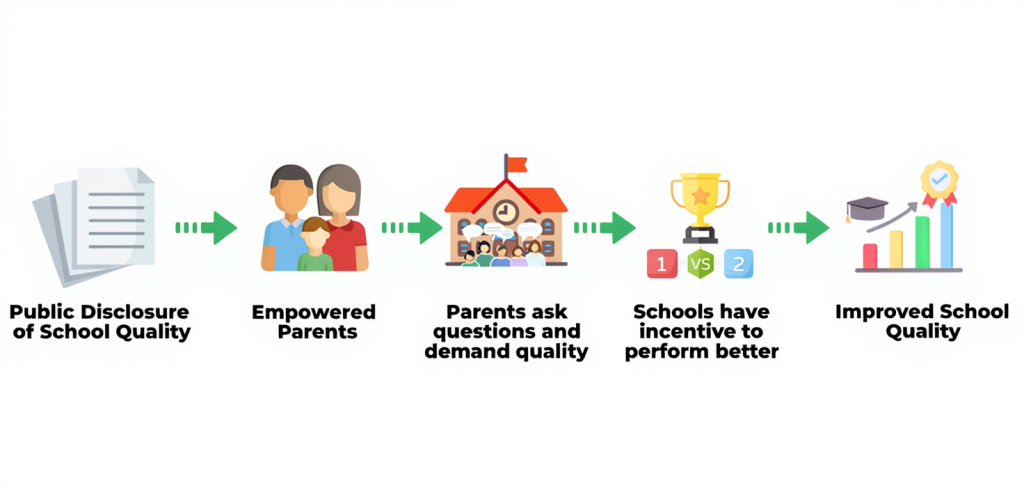
How Public Disclosure Drives Improvements in School Quality
The Missing Measure in School Governance
The current regulatory system focuses on inputs such as the availability of classrooms, infrastructure norms, teacher qualifications. While these indicators play an important role in ensuring schools meet minimum operational standards, they do not answer the question families care about most: whether students in a given school are actually learning.
This emphasis on inputs is also reflected in the signals schools communicate publicly. Information about infrastructure and facilities is often more visible than credible measures of student learning. In the absence of comparable information on learning outcomes, parents frequently rely on such indicators when judging school quality.
As a result, parents have limited ability to demand improvements in the quality of education their children receive. Administrators may also find it difficult to identify which schools require targeted academic support. Schools themselves operate without comparable information on how their performance relates to that of other schools around them.
In effect, the system lacks a shared reference point around the outcome that matters most. India’s National Education Policy (NEP) 2020 explicitly recognises this gap and proposes a structural shift in how school accountability should function.
What NEP 2020 Envisioned
NEP 2020 calls for greater transparency around school performance as a way to improve educational outcomes. The policy recommends that both government and private schools publicly disclose student outcomes on standardised assessments such as the National Achievement Survey (NAS) and/or state-level evaluations for continuous monitoring and improvement of the schooling system. These assessments, conducted at scale across schools, can provide comparable information on student learning across the system.
To ensure that such disclosure is credible and consistent across all schools, the policy proposes the establishment of an independent, state-wide, regulatory body: the State School Standards Authority (SSSA). The SSSA is expected to define transparent self-disclosure formats and ensure that information about school performance is publicly available for all schools, whether public or private. By enabling transparent and comparable reporting of school performance, this framework seeks to strengthen accountability and public oversight for learning outcomes across the education system. A growing body of research suggests that such public disclosure can influence accountability and improve learning outcomes.
Research Evidence on Information and Accountability
Research in rural Rajasthan found that when both schools and parents received clear information about student learning levels and comparative school performance information, learning outcomes improved.
Global policy discussions have also highlighted the importance of information transparency. The Global Education Evidence Advisory Panel (GEEAP) identifies providing information on school quality as one of the most cost-effective interventions for improving learning outcomes.
Taken together, this body of research suggests a simple insight: information alone may not guarantee accountability, but without credible information meaningful accountability is difficult to achieve.
From Intent to Practice: Lessons from Jodhpur
The Jodhpur pilot provides an example of how public disclosure of school-level learning outcomes can be implemented in practice.
In one block of the Jodhpur district, competency-based assessments were conducted across 54 Mahatma Gandhi Government Schools. The results were aggregated to generate school-level learning data, which was then translated into simplified report cards and shared with principals, teachers and parents.
Designing these report cards required several rounds of iteration. Initial formats experimented with emoji-based representations of performance levels and colour-coded indicators, but these proved difficult for many parents to interpret. What eventually proved most effective was a straightforward format that led with a clear summary score, accompanied by a short explanatory video in the local language.
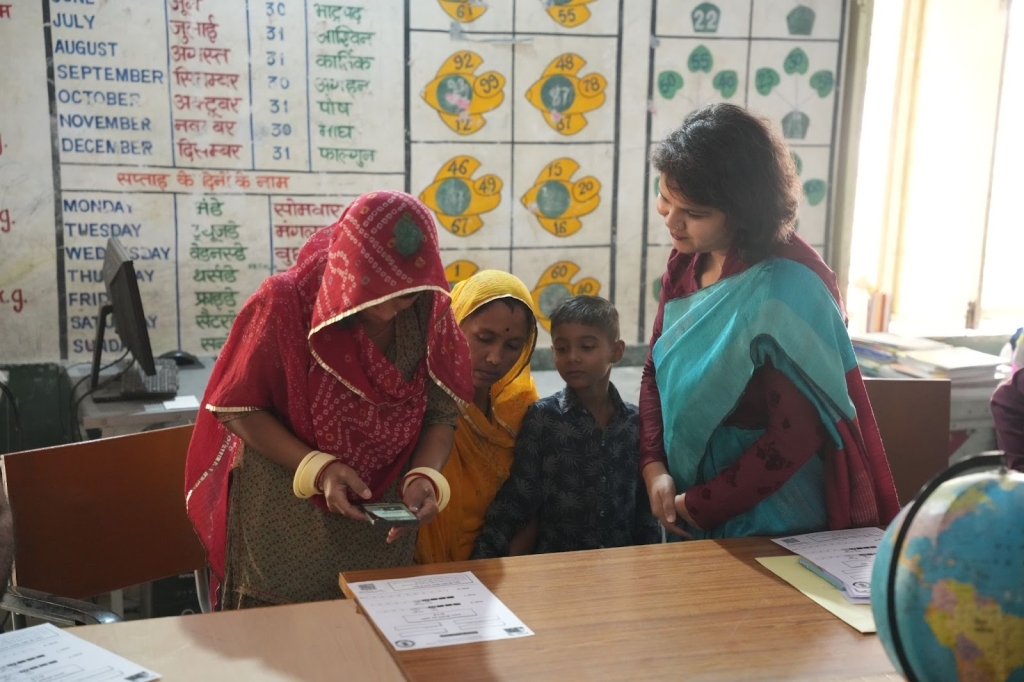
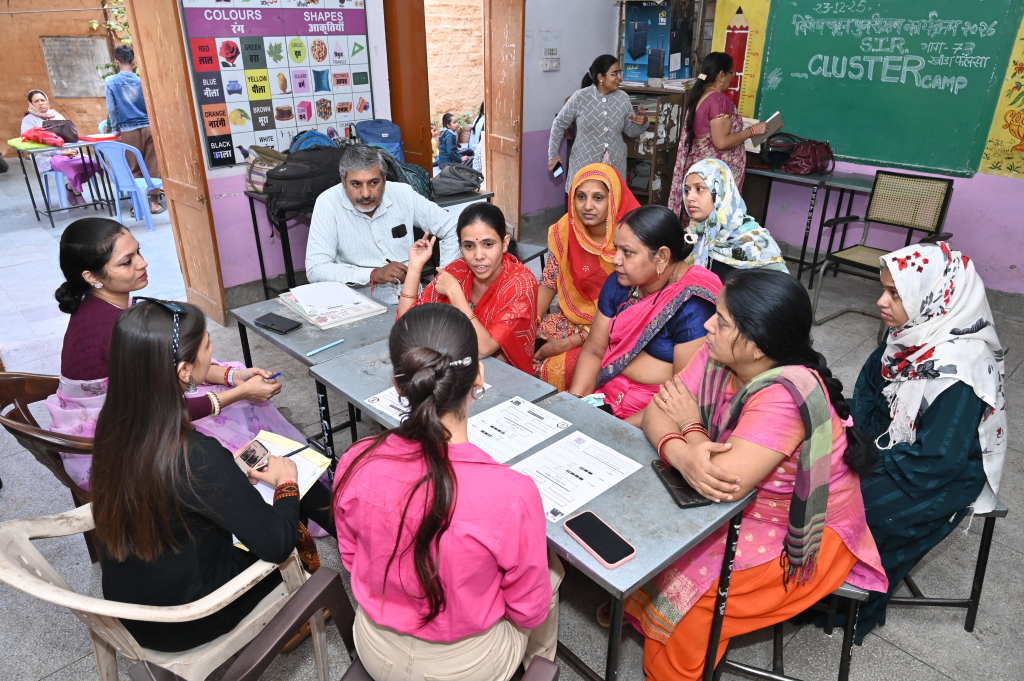
This process underscored an important principle: for information to drive engagement, it must be presented in a form that communities can easily understand. When the report cards were shared with parents, many were eager to understand what the scores meant for their schools. Some parents asked school leaders how they planned to improve the results, while others remarked that the scores reflected challenges they had observed in the functioning of the school.
These early interactions suggest that when credible and accessible information about learning outcomes is made available, communities are willing to engage more actively with schools on the question that matters most: whether children are learning. This can strengthen community connect, deepen parent engagement and sharpen schools’ focus on improving learning outcomes. The challenge, therefore, is not parental apathy but the absence of clear and comparable information that enables such engagement.
Institutional Conditions for Meaningful Disclosure
The Jodhpur experience also highlights the limits of transparency alone. Even when parents possess credible information about school performance, they may lack the institutional channels required to translate concerns into action. Information can initiate a conversation, but sustained accountability requires structures that ensure the conversation leads somewhere meaningful.
This insight points to the importance of institutional arrangements that can support credible and consistent disclosure of school performance.
First, the assessments underlying school report cards must be reliable and competency-based. Data that is inconsistent or perceived as unreliable will quickly lose credibility among parents, teachers and administrators.
Second, the authority responsible for conducting and disclosing those assessments must be institutionally independent. When the same institution both operates schools and evaluates them, questions about impartiality inevitably arise.
This is precisely the role envisioned for the State School Standards Authority (SSSA) under NEP 2020. By establishing an independent body responsible for defining disclosure standards and ensuring that school performance information is publicly available, the policy seeks to create the institutional foundation required for transparency to translate into meaningful accountability.
Looking Ahead
The Government of Rajasthan has already begun expanding the Jodhpur initiative beyond its original pilot. School report cards are being extended from one block to all fifteen blocks in the district, along with an additional block in Jaipur, bringing the initiative to ~1,500 schools. It is encouraging to see the vision outlined in NEP 2020 beginning to take shape on the ground.
For such efforts to meaningfully improve learning outcomes, however, public disclosure must become a sustained practice rather than a one-time initiative. School-level learning data needs to be generated and shared consistently year after year so that it becomes a reliable reference point for schools, administrators and communities.
There is also a need to ensure that this information reaches the widest possible set of stakeholders. Local institutions such as School Management Committees, Panchayati Raj Institutions and community groups can play an important role in interpreting and acting on this information. When credible learning data becomes widely available and embedded within local governance processes, it can encourage greater engagement from parents and communities and strengthen collective responsibility for improving school quality.
Making school learning visible may appear to be a simple reform. In practice, it represents a significant shift in how education systems relate to the public they serve. When learning outcomes become visible to every parent, community member and stakeholder in the system, accountability for learning can begin to take root in ways that drive sustained improvement in educational outcomes.
Keywords
Authored by

Ann Ria Reji
Program Manager, School Governance, Central Square Foundation

Komal Kasera
Project Lead, School Governance, Central Square Foundation
Share this on