


 Go Back
Share
NIPUN Bharat Mission at Five: What Worked, What Next
By CSF Editorial Team and Ishmeet Singh
Jun 23, 2026
The NIPUN Bharat Mission has transformed foundational literacy and numeracy into a national education priority, driving improvements in early-grade learning through structured teaching practices, clear learning goals and stronger classroom systems. In this article, Ishmeet Singh, CEO, Central Square Foundation, reflects on the mission's progress, highlighting gains in foundational learning outcomes and the importance of teacher support, regular assessments and data-driven decision-making. Looking ahead, he emphasises for a strengthened Phase 2 of the NIPUN Mission to expand support across Grades 3-5, reinforce early childhood education, teacher mentoring and governance and ensure every child develops the foundational skills needed for lifelong learning and India's Viksit Bharat 2047 vision.
The five years of the NIPUN Bharat Mission across states have fundamentally reshaped how India approaches early learning with clear goals, well-designed teaching-learning material (TLM), meaningful investments in teacher capacity, sustainable architecture for assessments and data-driven decision-making. NIPUN Bharat is arguably one of the most complex, large-scale education transformations underway anywhere in the world. And its success hinges on the simple truth that learning happens when the intent of policy documents is visible in the teaching and learning in every classroom, by all our teachers for all our students, every day.

Today, what may seem like a subtle shift is, in fact, brewing a bigger transformation – NIPUN Bharat truly grew past policy into purpose, shaping both minds and India. In Foundational Literacy and Numeracy (FLN), we saw remarkable gains across India, especially among children in government schools, an encouraging first in two decades. The PARAKH Rashtriya Sarvekshan (PRS) 2024 results signalled a strong shift. Grade 3 students who have benefitted from the three years of NIPUN Bharat performed the strongest, scoring 64% in Language and 60% in Math, outperforming those in Grades 6 and 9. The Annual Status of Education Report (ASER) 2024 also reaffirmed this progress, with India seeing a positive trend in foundational literacy with ~3 percentage points gains and foundational numeracy with ~7 percentage points gains from 2018 to 2024, respectively.
With India moving closer to its 2047 Viksit Bharat goal, what and how our children learn today becomes absolutely key for it will impact how strongly our nation stands later. As we celebrate the measurable gains in learning outcomes and the systemic transformation delivered under NIPUN Bharat Mission, it is worth taking stock and reflecting on what worked and works, what remains to be done (opportunities) and how we can strengthen the mission going forward.
What Works – Key Enablers of NIPUN Bharat Mission
The NIPUN Bharat Mission has empowered states to develop and institutionalise contextualised practices that meaningfully improve student learning. This is what has worked across six critical workstreams under NIPUN.
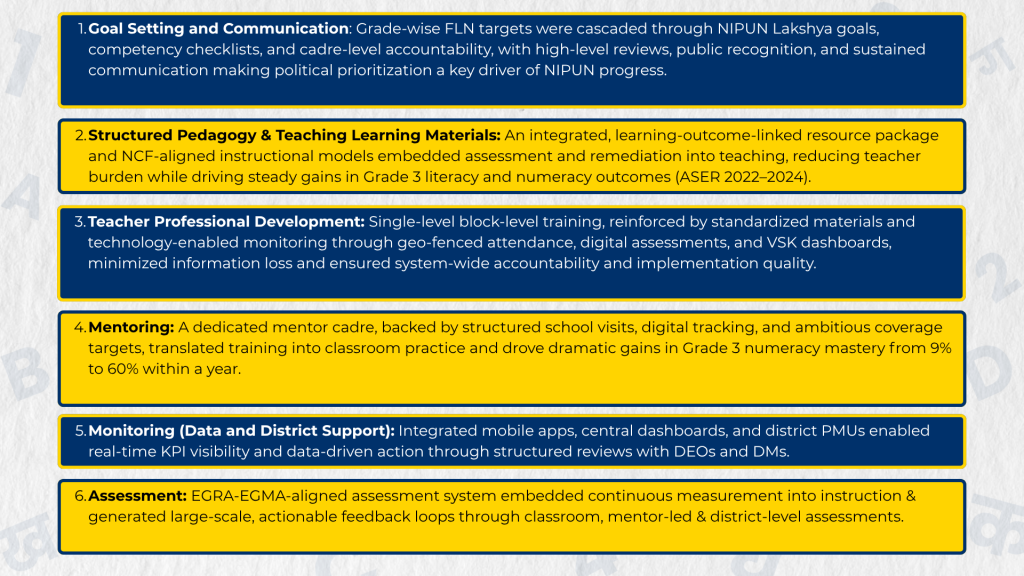
Key enablers of NIPUN Bharat Mission
As we celebrate these gains made under NIPUN Bharat, it is equally important to examine the gaps that remain, using them as opportunities to strengthen implementation and deepen impact in the years ahead.
Implementation Gaps and Systemic Priorities for Strengthening Foundational Learning
NIPUN Bharat Mission established a strong national architecture for FLN. Notwithstanding the considerable progress made, implementation of certain systemic elements can be strengthened, with consistent depth across all states. The gaps identified below reflect shared structural challenges, many of which were visible in the broader education ecosystem and offer clear entry points for the next phase of NIPUN Bharat Mission.
- Governance and Monitoring
While national targets were clearly articulated, they were not set in alignment with the National Mission and translated into mission-aligned, measurable annual goals at the state, district and block levels. Without a shared accountability chain and clearly defined milestones, implementation in several states remained effort-focused rather than outcome-oriented. As a result, governance and review mechanisms often lacked a clear set of learning-focused indicators against which progress could be assessed and corrective action taken.
District Programme Management Units and Block Mission structures were established in most states, but their effectiveness was uneven. Where review meetings occurred, they tended to focus on administrative compliance, fund utilisation and activity completion rather than learning outcomes, instructional quality and implementation fidelity. A functioning review ecosystem requires dedicated technical capacity, real-time data dashboards, structured problem-solving routines and regular field engagement, elements that were present in some states but not yet institutionalised across the system.
2. Foundational Gaps and Regression of Learning After Grade 2
It has been indicated that the NIPUN Bharat Mission will include Grades 3-5 – a much needed move. But apart from defining grade-level competencies for Grades 3-5, the mission also needs to focus on acquisition of FLN skills in these grades as ASER and Parakh Rashtriya Sarvekshan (PRS) 2024 show that many children entering Grade 3 still lack FLN skills, further leading to Grades 3-5 classrooms inheriting wide learning variation, with some children needing foundational recovery and others needing support to reach grade-level competencies. Yet, the system offers no structured continuum beyond Grade 2: no clear At-Grade and Remedial pathways, no differentiated instructional support and no formal mechanisms to track or recover foundational gaps.
3. Linkages with Balvatika and Pre-Primary Education
NIPUN Bharat’s operational focus was largely on Grades 1-2, with limited integration of the pre-primary years that NEP 2020 envisions as the true beginning of the foundational stage. While Balvatikas were established in select states, they received insufficient pedagogical guidance, trained facilitators and monitoring support. As a result, many children continued to enter Grade 1 without adequate school readiness – a critical upstream driver of foundational learning gaps. Despite strong Balvatika learning goals, the absence of a nationally defined school readiness marker limits accountability for early learning outcomes. Strengthening the continuum from Anganwadi through Balvatika to Grade 1 remains an urgent priority for NIPUN 2.0.
4. Teacher Training and Mentoring
Large-scale training efforts were undertaken, yet the predominant model, residential, cascade-based and largely one-time, had inherent limitations in ensuring depth and consistency of impact. Without a Teacher Competency Framework anchoring what teachers need to know and be able to do at each stage, training content remained generic. Sustained instructional change requires a shift toward continuous professional development pathways, including blended learning and structured classroom coaching, which were not yet scaled in most states.
However, training alone is insufficient to drive sustained changes in classroom practice; it must be reinforced through strong, school-based academic support systems. The quality of FLN delivery in the classroom depends critically on the academic mentoring and coaching capacity of Cluster Resource Persons (CRPs) and Block Resource Persons (BRPs). Yet evidence shows monitoring systems have been reduced to data collection exercises. The data these visits collect is rarely used for instructional decision-making or targeted teacher support and while dashboards exist in many states, they are not consistently used at the school or cluster level for course correction.
5. Assessments
At the National Level: Tracking NIPUN’s progress from the national to the school level depends on assessment data that is both comparable and diagnostic. Current national and state-level assessments run on differing methodologies, so their results do not speak to one another and most gauge grade-level attainment rather than revealing where a child stands against foundational benchmarks, limiting the ability to track progress and target remediation.
At the State Level: Several states designated assessment units within the State Council of Educational Research and Training (SCERT); however, these cells were often under-resourced and reliant on external agency support. Most lacked the in-house capacity for item development, psychometric validation, longitudinal tracking, or data dissemination. As a result, state-led assessment remained episodic rather than evolving into an embedded technical function capable of continuously informing pedagogy and policy decisions.
Assessment-Informed Instruction: Periodic assessments were conducted widely, yet the data rarely fed back into instructional decisions in time. Formative tools tended to serve as reporting mechanisms rather than diagnostic instruments to identify learning gaps and tailor teaching accordingly. The missing elements were competency-wise assessment ladders aligned to classroom practice; teacher-friendly diagnostic tools for daily and weekly remediation; structured remediation protocols linked to assessment findings; and mechanisms to feed classroom-level learning data into block and district reviews.
6. Structured Pedagogy Adoption: From Procurement to Practice
Under NIPUN Bharat, many states invested in teacher guides, lesson plans, workbooks and teaching-learning materials (TLMs). While these resources reached schools, the shift in classroom teaching that they were intended to drive has been uneven. In many cases, teachers received the materials but did not receive sufficient ongoing support to effectively use them in classrooms. As a result, structured pedagogy is often seen as a set of materials rather than a way of teaching that helps all children learn systematically.
A major challenge is that the education system continues to be designed around grade-level expectations, while classroom realities are very different. The curriculum assumes that a child entering Grade 3 has already acquired foundational reading and numeracy skills. However, many classrooms include children with widely varying learning levels, from non-readers to children performing at grade level. Despite this, teaching, assessments and monitoring systems largely follow a one-size-fits-all approach focused on completing the syllabus rather than ensuring that every child achieves the required competencies.
Teachers often lack practical tools and support to address this diversity. Many do not have access to clear competency-based lesson plans, classroom grouping strategies, or guidance on how to teach children at different learning levels within the same classroom. Remediation is frequently implemented as a special activity or short-term campaign rather than being integrated into daily teaching. As a result, children who fall behind often continue to move through grades without receiving the support needed to catch up.
Academic support systems also remain focused on training teachers to use materials rather than helping them strengthen classroom practice. Regular coaching, classroom observation and instructional mentoring are limited in many states, reducing opportunities for teachers to improve teaching strategies and respond to student learning needs.
While NCF-SE 2023 highlights the importance of competency-based learning and differentiated instruction, most states do not yet have a structured system that combines at-grade teaching with continuous remediation. There remains a need to build an instructional model that enables teachers to assess learning levels, group children based on need, provide targeted support, and track progress over time. Without such a system, investments in materials and training alone are unlikely to deliver the desired improvements in foundational literacy and numeracy.
Recommendations for the Next Phase of NIPUN Bharat Mission
To achieve the goal of universal FLN and realise the vision of a Viksit Bharat, the NIPUN Bharat Mission needs to be strengthened and sustained in the following ways:
1. NIPUN Bharat Extension and Continuity
- At-Grade Learning Outcomes for Grades 3 to 5
There should be at-grade learning outcomes for key competencies required from students in Grade 3-5, aligned with the National Curriculum Framework (NCF), also PRS and National Council of Educational Research and Training (NCERT) Textbooks. At-grade Lakshyas (End-of-Grade Learning Goal) and Soochi (Key Assessment Milestones) should be developed and mapped to NCERT textbook progression for Grades 3 to 5. NIPUN 2.0 should also strengthen existing Foundational Numeracy Competencies by extending them toward Procedural Fluency, Reasoning and Application in Grades 3-5.
- Remedial Learning Outcome for Grade 3 to 5
While grade-level progression must continue, remediation structures should be focussed on target struggling learners. Aligned with NCF (including PRS) and NCERT textbooks, remedial learning outcomes should focus on key competencies from two grades below (n-2) for Grades 3-5 students, while writing competencies should follow a one-grade-below (n-1) approach. Remedial goals must be developed and tracked for each student. Moreover, a comprehensive package for remedial instruction must be developed and incorporated into the academic materials and time-table.
- Elevate NIPUN Bharat as a Dedicated Mission-Mode Programme
NIPUN Bharat should be elevated into a standalone, 10-year national mission with a targeted roadmap for focussed ownership, uniform standards for pedagogy, assessments and training, prioritised funding, robust monitoring provisions, social mobilisation and capacity building of educators.
- Universalisation of Balvatika
A clear national priority must be established for the holistic development of children from pre-primary (Balvatika) to Grade 5, recognising that the early years are critical for later learning and that later interventions are less effective without a strong foundation. This should be done by focussing on three key levers including universalisation of Balvatika-3, ensuring a dedicated ECE Educator cadre and allocation budget for the phased establishment of Balvatikas/pre-school sections in schools.
- Teaching-Learning Materials (TLM), Provisioning and Instructional Architecture
- Redesign Teaching-Learning Material (TLM) and Provisioning
Teaching-learning materials should be redesigned to support effective classroom instruction and remediation across Grades 3-5. This includes developing teacher guides, workbooks and supplementary learning resources aligned to the state’s competency progression and classroom instructional needs. A strengthened TLM provisioning model should ensure availability of school-level materials, child-wise learning resources from Balvatika to Grade 5, and enhanced teacher support resources.
- Dedicated Instructional Timetable
A dedicated instructional timetable should be introduced to improve implementation fidelity and learning outcomes. Specific time allocations for Hindi and Mathematics should be defined, along with a daily 30-minute reading block and dedicated practice time for numeracy. States may also consider deploying 25-week teacher guides with daily lesson plans targeting specific competencies and incorporating dedicated time for ongoing remediation within regular classroom instruction.
- Teacher Training, Capacity Building and Mentoring
- Integrated Teacher Capacity Building
A unified teacher training framework must be developed that prepares teachers to teach across the entire Foundational & Preparatory stage. We should now look at moving beyond traditional residential models to include hybrid courses, self-paced learning programmes and access to professional learning platforms offered by reputed organisations, backed by a mix of flexible training strategies, aligned with the National Professional Standards for Teachers (NPST), as outlined in the NEP 2020. There is a need to ensure that training content covers Multi-Grade Multi-Level (MGML) teaching, which affects nearly 70% of primary schools. Moreover, FLN outcomes must be integrated into teacher appraisal frameworks, supported by a robust, tiered, recognition system (school/block/district/state NIPUN Champions) where professional development access is tied to outcome progress.
- Reduce Training Cascades
Multi-level training cascades must be minimised to avoid cascade loss and effective knowledge transfer. We should look at training teachers directly at the block level through a single-level cascade model to reduce information loss and increase effectiveness. This could be benchmarked against the Madhya Pradesh model, where 1.78 lakh teachers across Grades 1-3 were directly trained annually.
- Strengthen Mentoring Systems
There must be a dedicated budget provisioning for Mentor Capacity Building (Rs. 1,000 per mentor per day) for specialised training programmes. Moreover, mentors should be allowed to reimburse mentor travel, learning resources and costs for conducting one-on-one or group mentoring sessions (online and offline).
- Structured Mentor Protocols at Schools
We must develop clear mentor protocols ensuring that classroom observations and interactions with head teachers are structured and impactful. For this, we could adopt a 2-hour mentor protocol with 40 minutes for classroom observation, 20 minutes for teacher feedback, 40 minutes for student assessment and 20 minutes for discussion with the teacher and head teacher. Lastly, we should look at conducting monthly spot assessments by external mentors to identify struggling students and guide remediation efforts.
- Assessments and Data Systems
- Census-based Assessment for Grade 5 Students
To receive real-time diagnostics of learning quality across every school, block, district and state in India, census-based assessment is required, as proposed in the NEP 2020.
- Establish a Centre of Excellence for Educational Assessment and Planning (CEAP)
States require more frequent and granular student learning data, enhanced capacity and mechanisms to drive data use for planning and decision-making. A Centre of Excellence for Educational Assessment and Planning (CEAP) should be established at every state level as an independent technical institution to drive assessment framework development, conducting formative, summative and large-scale assessments across key stages, creating data systems for data analysis, educator training and communication and community engagement around learning outcomes.
- Facilitate Data Usage from Formative Assessments
We should train teachers on how to effectively utilise formative assessment data to enhance classroom instruction, design remedial lessons and ensure all students achieve NIPUN competencies. We should look at integrating formative assessments into workbooks to provide timely insights for early identification of learning gaps. Lastly, structured models such as 5+1 (five days instruction, one day assessment and remediation) or 4+1+1 (four days instruction, one day assessment, one day remediation) should be adopted.
- Conduct District-level Annual Assessments
We should implement annual district-level assessments to track NIPUN Bharat outcomes and provide insights into the health of the education system at the district level. For this, we must enable district administrations to make informed decisions and take targeted actions to improve learning outcomes.
- Streamline Large-scale Assessments
We should look at rationalising assessment methodologies of PARAKH Rashtriya Sarvekshan (PRS) and the Foundational Learning Study (FLS). Adopting the FLS methodology for Grade 3 to 5 could provide a more accurate measure of foundational skills in reading fluency and numeracy sub-skills. We should implement a standardised framework for state assessments to ensure comparability of results and align national and state assessment frameworks to allow states to identify systemic weaknesses and inform corrective policy decisions. This should be backed by EGRA-EGMA standards for assessments to pinpoint specific learning gaps and enable targeted policy adjustments.
- Tech-enabled Real-time Data Systems
Comprehensive FLN monitoring systems should be implemented where data collected by mentors from the classroom is emitted into dashboards used in review meetings from district to block to school level. We should focus on setting school visit targets for mentors to generate comprehensive data and guide interventions. Targets for this data collection should be integrated with unique school coverage (benchmark: 75%) through clear mentoring targets, improving monitoring and compliance.
- Home Learning
NIPUN Bharat Mission focuses on the involvement of community and parents in students learning, backed by the NEP 2020. To strengthen this, we must institutionalise a system- anchored, parent-supported, home learning as a core pillar of NIPUN 2.0, where parents are empowered through technology to become active partners in their children’s learning. Samagra Shiksha contains the structural elements needed and can further leverage existing NIPUN architecture for institutionalisation.
- Governance and Administration
- Reactivate the National Steering Committee (NSCs) and Reviews
The NIPUN Bharat Mission Guidelines call for the establishment of a National Steering Committee to monitor the progress of the Mission. The Ministry of Education should mandate bi-annual National Steering Committee (NSC) meetings with an agenda tied to outcome data. This could include Chief Secretaries from focus states, supported by circulation of pre-read dashboards and the publishing of action-taken reports. We could look at reactivating the committee, broadening its membership to include Ministry officials, civil society organisations and industry partners. Moreover, we should adopt a whole-of-society approach to assess progress, identify challenges, generate bottom-up insights from the field and enable cross-state learning and collaboration.
- Establish National Cadence with the State
We should look at establishing a dedicated National Project Management Unit (PMU) under the Department of School Education and Literacy (DSEL) with full-time mission leads, FLN specialists and monitoring and evaluation (M&E) staff. This PMU should own annual state reviews, technical assistance coordination and knowledge management. We must institute a quarterly Secretary level review of all states — using a common scorecard tied to NIPUN Bharat Mission Planning and Implementation Template (NBMPIT) KPIs — with follow-up action items formally communicated to states. This should be backed by institutionalising annual joint-review meetings (JRMs) for all states with national-level participation. For this, we could look at developing a standardised JRM protocol assessing classroom processes, data use, and governance systems. We could also look at creating a National FLN Learning Exchange to conduct quarterly peer-learning convenings. To bring all of this together, we must build a political accountability narrative by linking FLN outcomes to PM/CM-level flagship dashboards (e.g., PM Poshan, Viksit Bharat targets).
- Institutionalise State Steering Committees and District and Block FLN Committees
With a long-term focus on meeting the objectives of the NIPUN Bharat Mission, State Steering Committees should focus on supporting districts in identifying implementation challenges and creating actionable plans; promoting contextualised teaching practices and improve last-mile delivery of quality interventions; facilitating partnerships with local NGOs and organisations to drive student attendance and encourage local-level innovation; reviewing district-wise NIPUN scorecard data and constituting District & Block FLN Committee with monthly review cadence, chaired by DM at district level and BEO at block level. Equip DEOs & BRCs with digital monitoring tools and scorecards.
- Professional Administrative Hiring at the State and District Level
We should look at creating dedicated long-term positions and institutionalise an Assistant State Project director (SPD)-level role to ensure continuity in the Mission’s implementation. At the district level, we should also focus on getting young professionals to support the administration in meeting operational demands and ensuring implementation fidelity and ensuring each district has a full-time FLN coordinator. Lastly, the performance of districts (on a standard NIPUN scorecard) should be linked to District Magistrate/District Collector (DM/DC) quarterly reviews and visible public dashboards.
- Set NIPUN Targets
State Targets: we should attach time-bound targets to all 22 NIPUN Bharat Mission Planning and Implementation Template (NBMPIT) indicators and convert NBMPIT into a governance decision tool: bi-annual state-wise performance ratings, should feed into Annual Work Plan & Budget (AWPB) approvals and Samagra Shiksha fund releases.
School Targets: we should equip school head teachers with accurate data and incentivise them to establish clear, school-level targets ensuring every student achieves NIPUN status by Grades 2 and 3; consolidate individual school targets at the block, district and state levels and leverage monitoring data from mentors to track progress towards the goal of 80% of schools meeting the NIPUN benchmark by 2032.
- Strengthen Data Systems and Vidya Samiksha Kendras (VSKs)
We must look at systematically collecting and integrating robust data on key accountability metrics including student and teacher attendance, delivery of teaching-learning materials, teacher guide usage and teacher performance. This data should be made accessible to officials at the district, block and school levels to incentivise best-performing teachers, head teachers and local officials.
If we can prioritise, embed and institutionalise even a few of these recommendations at scale, NIPUN Bharat can move closer to fulfilling its core promise: ensuring that every child acquires strong foundational literacy and numeracy skills, laying the groundwork for achieving the SDG goals and for a Viksit Bharat by 2047.
Keywords
Authored by

CSF Editorial Team

Ishmeet Singh
CEO, Central Square Foundation
Share this on