


 Go Back
Share
Building Spaces for Career Exposure in CM SHRI Schools: Reflections from the Industry Immersion Programme 2026
By Damini Jain and Khushboo Arora
Oct 22, 2026
By Grade 12, students are expected to make some of the most consequential decisions of their educational journeys, yet they reach the end of secondary school with little firsthand understanding of how different professions actually function. Delhi's CM SHRI Schools offer an important setting to act on this gap. This article offers reflections from CM Shri School Students and their experiences in the Industry Immersion Program, which is designed to play a bridging role between school-based learning and future professional pathways.
In the summer of 2026, five Grade 12 government school students from CM SHRI School, Raj Niwas Marg, with an interest in technology walked into an Indian Air Force facility in Delhi. Over the next four weeks, they worked with professionals on data analytics and generative AI, built a quiz-generation application called Quizify, and presented their work to senior technical officers. The confidence boost of having the opportunity to learn and getting recognised directly from someone they looked up to made the possibility of a career in technology feel more real. For perhaps the first time, a career they had only imagined became something they could see themselves doing.

By Grade 12, students are often expected to make some of the most consequential decisions of their educational journeys: which courses to pursue, which college to apply to, and eventually, which professional paths to consider which often determines their lives post school. However, despite spending over a decade in formal education, most students reach the end of secondary school with little firsthand understanding of how different professions actually function. This is because career knowledge is shaped more by social background than by structured exposure to the world of work itself. The challenge is not a lack of aspiration, but of exposure, guidance, and access. International research shows that structured internships and workplace experiences during school years significantly improve students’ career development by strengthening their understanding of real-world work, thereby increasing motivation, and supporting career exploration1. Yet for students from underserved backgrounds, access to such experiences remains limited, leaving career choices shaped more by hearsay than by informed guidance.
The CM SHRI Schools created by the Government of Delhi offer an important setting to act on this gap. This ecosystem brings together 75 model government schools designed to provide high-quality, future-oriented learning aligned with the National Education Policy 2020. CSF’s work in these schools currently focuses on strengthening future pathways, career preparation, and academic enrichment for High Potential Students from Grades 6 through 12.
As students approach the transition from school to higher education and work, ensuring they have the knowledge, confidence, and exposure to navigate it well becomes particularly important. The Industry Immersion Program was designed to play a bridging role between school-based learning and future academic and professional pathways by helping students of Grade 12 move from abstract ideas of careers to an informed understanding of everyday professional practice and expectations. The first year of the programme sought to take career exploration beyond information and aspiration. Students were connected with organisations aligned with their interests and given opportunities to work alongside professionals, undertake meaningful tasks, receive mentorship, and reflect on what they were learning.
The programme was built around three interconnected objectives – career awareness, skill development, and equitable access – each reinforcing the other to ensure that students are not only informed about professional pathways but also equipped and supported to pursue them. The vision alone, however, does not suffice. The real texture of the programme lives in what students did, built, and discovered about themselves inside workplaces they had never set foot in before.
Vedya Partners
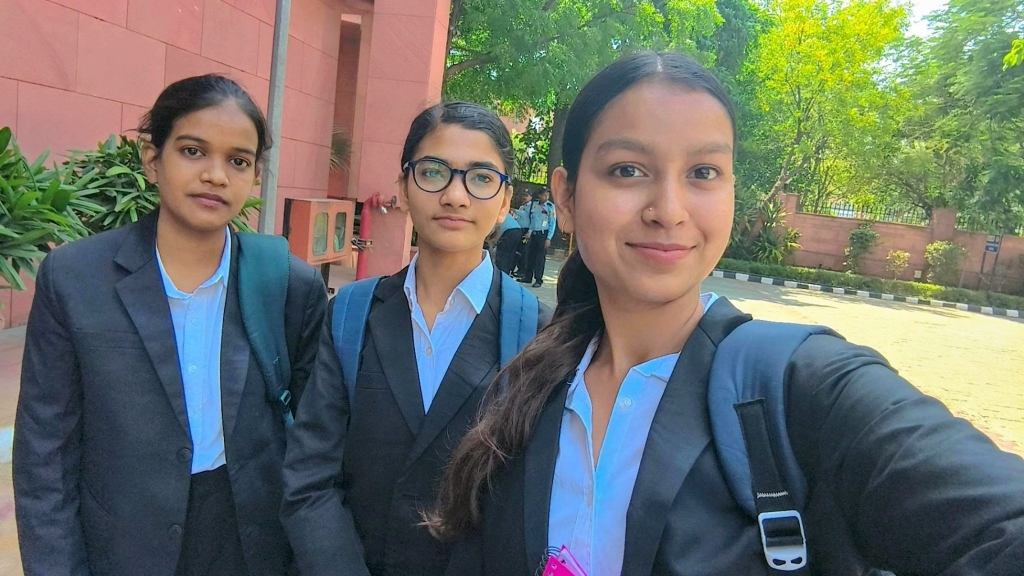
Three students from CM SHRI School, Kalkaji, stepped into the world of litigation for a short but intensive immersion at Vedya Partners, a law firm based in Delhi. They read case files, researched case law, and observed proceedings at the Delhi High Court, the Central Administrative Tribunal, and Patiala House Court — all within roughly 10 days.
Aanshika described visiting the High Court and watching case hearings as her proudest moment: “Now I am very clear about my future career paths. I am going to choose corporate law.” Priyanshi, who initially struggled with legal terminology, found her footing after her mentor showed her how to read a case file properly. “I was surprised by how much legal work relies on reading between the lines and understanding the intent behind a law, rather than just looking at the literal text,” she reflected — a shift in perspective she had not anticipated.
Despite being the programme’s briefest engagement, Vedya Partners produced one of its highest career-clarity scores: 8.33 out of 10.
Central Square Foundation
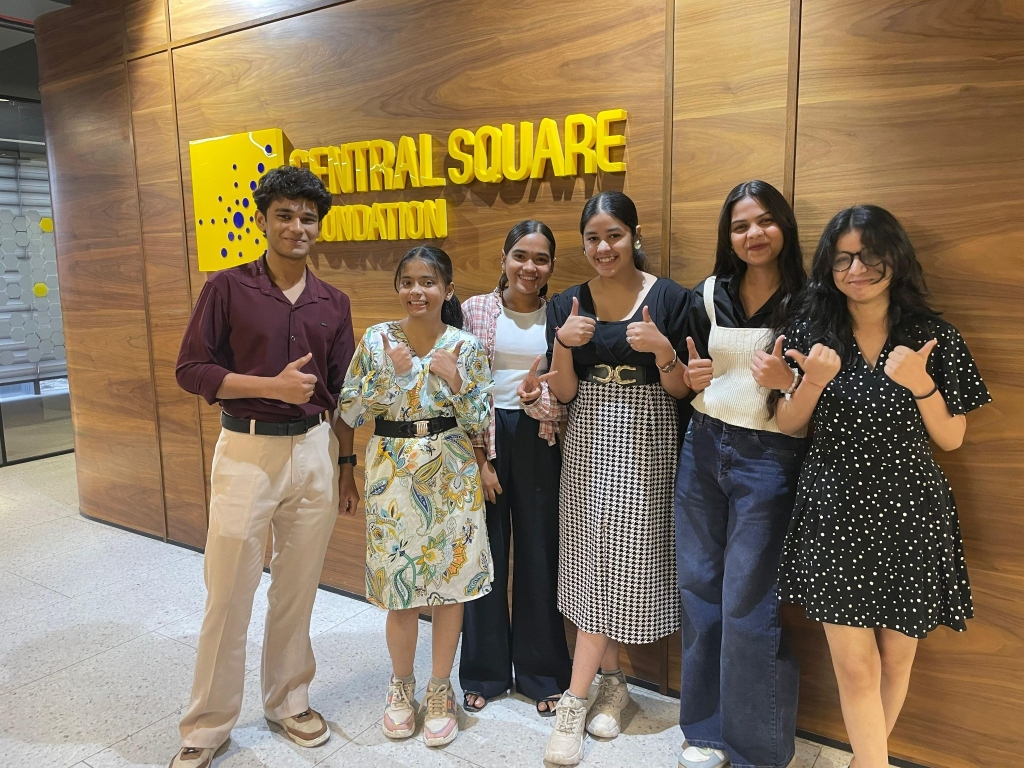
Six students from CM SHRI Schools in Kalkaji and Madanpur Khadar joined CSF for a month. Sanskriti Kumari, working with the policy and communications team, found herself doing things she had never imagined a Grade 12 student could do: reflecting on how educational videos are made, editing interview footage, and presenting technical concepts using everyday examples. “Each and every day felt like an achievement to me,” she wrote. “Getting chances to share my thoughts is something we usually don’t get.” Her mentors noted great confidence and in-depth knowledge during her final presentation.
Gauri, who had been unsure about what degree to pursue, found the conversations as valuable as the tasks. “Through conversations with mentors and colleagues about their school, college, and career journeys, I gained much more clarity about my ambitions, the college I want to attend, and the opportunities and internships I can explore in the future.”
Workshops with Pradipta Singh

At least 15 students from CM SHRI School, Sector-19 Dwarka were part of an individual mentor-led immersion in acting and the performing arts, and formed the third-largest cohort in the programme. Over three weeks, students participated in visual and performance exercises, working on team-building, communication, and story-telling through creative assignments. Towards the end, students scripted and filmed a short film, ‘When the Camera Stopped!’.
Chirag Gandhi, speaking about his main takeaways from the experience, shares:“I expected acting to be mainly about performing in front of the camera, but I discovered that rehearsals, script analysis, character development, teamwork, and taking direction are equally important. This experience taught me that discipline, patience, and continuous practice are essential for delivering a natural and convincing performance.” The programme, in this manner, did not only work to open new paths for students, but also to provide greater clarity and depth to the paths they had already chosen.
What Lies Ahead: Learning from Year 1
The figure below outlines the operational workflow that was undertaken by the team in 2026 to ensure effective implementation of the program.

| 120students completed an immersion* | 30+organisations approached | 12immersions delivered* | 27CM SHRI schools in the applicant pool |
The pilot exposed what must change for this to work at scale. Around half of all interested students could not be placed — capacity was the binding limit. Distance, cost of travel, and summer heat created constraints that surfaced in student feedback. Online immersions saw attendance challenges that hosts could not resolve alone.
Year 2 is being designed around these lessons. The operational workflow will be built to accommodate a three-way partnership: industry partners who supply structured opportunities, a central cadre of Educational and Vocational Guidance Counsellors (EVGCs) who coordinate the programme, and school-level teams who own day-to-day delivery.
The programme began with a conviction: every CM SHRI student should have access to career awareness, exposure, and exploration before making post-school choices. Year 1 showed that when students spend structured time inside real workplaces, the shift is immediate, personal, and lasting. The work now is to make it available to every student who wants it.
Keywords
Authored by

Damini Jain
Project Associate, Partnerships and Strategic Initiatives, Central Square Foundation

Khushboo Arora
Consultant, Partnerships and Strategic Initiatives, Central Square Foundation
Share this on