


 Go Back
Share
Reimagining Guru Goshthi: Building a Distributed Academic Support System in Bihar
By Shweta Chaubey and Suman Bharti
Sep 23, 2026
In this article, we explore how Jehanabad district in Bihar transformed an existing head teacher platform into a space for academic learning, peer exchange and school-level support. By strengthening its structure and building a network of 40 Resource Persons, the model shifted Guru Goshthi towards a more distributed system of academic support, with 95.1% of respondents reporting fully academic discussions by January 2026, compared with 1.38% at baseline.
Strengthening Systems for Academic Support
The NIPUN Bharat Mission, launched in 2021, aims to ensure that every child develops foundational reading and mathematics skills by the end of Grade 2. This requires not only effective classroom practice but also regular academic support for teachers and school leaders.
In Bihar’s Jehanabad district, an existing platform offered a natural entry point: Guru Goshthi, the monthly meeting of head teachers, typically led by the Block Education Officer (BEO). With 887 government schools across the district, the challenge was to use existing structures to bring meaningful academic support closer to schools.
Conversations with teachers and school leaders pointed to a clear gap: “We do not receive enough support at the school level. What should we do?” Rather than create a parallel mechanism, the district chose to re-purpose Guru Goshthi—shifting it from primarily an administrative forum to a platform for academic learning, peer exchange and school-level support.
What We Found
Field visits highlighted three areas where the Guru Goshthi could be strengthened:
- Greater structure around what the meeting should cover and how the available time could be used;
- Stronger communication and coordination between block officials and school leaders;
- More opportunities for substantive academic discussion alongside the meeting’s existing administrative functions.
The Idea: Repurpose, Don’t Reinvent
Rather than build something new, the existing Guru Goshthi offered an opportunity to strengthen a platform that already had institutional legitimacy; head teachers across the district were already part of it. By placing greater emphasis on relevant academic content, the meeting could become a regular touchpoint where head teachers strengthened their own practice and carried learnings to teachers in their schools.
The broader ambition was to strengthen the role of head teachers as NIPUN Leaders: school-level champions who take greater ownership of student learning outcomes. The proposal was taken to a District Task Force (DTF) meeting—a periodic forum where the district’s education leadership reviews challenges and discusses strategy. The approach received support to strengthen Guru Goshthi around three priorities: positioning head teachers as academic leaders, building their capacity to mentor teachers and strengthening classroom practice and student learning district-wide.
Validating Assumptions: The Baseline Study
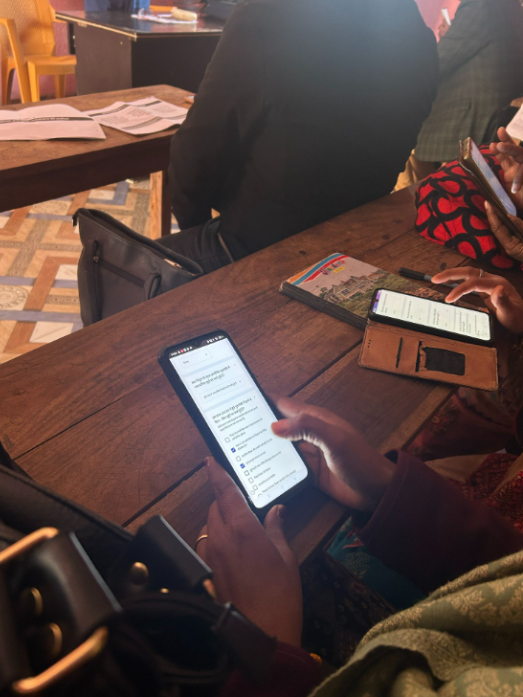
Before the revisions were introduced, a short baseline survey was conducted in the last week of July 2025 to understand how Guru Goshthi was functioning across the district. The results highlighted an opportunity to strengthen the platform’s regularity and academic focus:
- 61.4% of respondents were unable to confirm that the meetings were being held consistently across blocks.
- Of the meetings that did happen, 52.38% were mostly about reporting and data and 38.38% were mostly about distributing resources and materials.
- Only 1.38% of respondents recalled any real academic discussion taking place.
- Despite this, 71.5% of respondents said they believed Guru Goshthi could be turned into a genuine academic platform, a strong signal that the appetite for change already existed.
Building the New Model: A Distributed Academic Support Structure
Based on the baseline findings, a small number of concrete goals were established: put Guru Goshthi on a fixed annual calendar so that it took place consistently each month, increase the proportion of academic content to 90% of every meeting’s agenda and strengthen it as a Professional Learning Community—a peer group where head teachers actively teach and learn from one another, rather than simply receive instructions.
- Training Local Leaders to Conduct Guru Goshthi
A key design question was how to provide recurring academic support across 887 schools. The model therefore built a middle layer of 40 Resource Persons (RPs), selected from among head teachers and NIPUN Leaders from 100 ‘deeper intervention’ schools (schools that had previously received more intensive, hands-on support and training). Because these RPs already had hands-on NIPUN experience, they were well placed to facilitate academic discussions at the block level themselves.
- Calendarising for Consistency
An annual NIPUN Guru Goshthi calendar was developed with fixed dates aligned to each block’s schedule, making the meeting a predictable and regular part of the school year.

- Orienting Everyone to their New Roles
Before rollout, a one-day orientation was conducted for BEOs and the newly selected RPs, focusing on the purpose of the redesigned meetings and the roles each person would play in making them more academically focused.

- A Monthly Delivery Cycle
Each month, a fresh academic module was prepared around current classroom and school-level challenges. RPs attended a short orientation on that month’s content, then each facilitated a session for a group of roughly 50 head teachers at the block level, with BEOs providing local support. The resulting delivery structure was deliberately distributed: a small district team supported the academic design and preparation; 40 locally embedded RPs carried the academic facilitation closer to blocks and schools; BEOs supported implementation locally; and head teachers participated as both learners and peer academic leaders.


Is It Working? The Numbers Say Yes
Towards the end of the AY 2025-26, in January 2026, we repeated the survey to see what had actually changed. At this point, the endline survey showed a substantial shift: 95.10% of respondents reported that Guru Goshthi meetings were fully focused on academic discussion, compared with 1.38% at baseline.

What Changed Beyond the Numbers
The substantive impact may be harder to reflect on a chart. Head teachers reported feeling more confident and better equipped to support their teachers, rather than simply relaying instructions.
Among the Resource Persons, a similar shift took place. In the early months, they ran sessions with substantial hands-on support from the district team. Over time, they became more confident facilitators and mentors in their own right, increasingly recognised within their blocks as academic leaders. All 40 were formally felicitated by the District Education Officer (DEO) for their voluntary contribution to the initiative. The Head Teacher from Ratni Faridpur Block of Jehanabad shared that
“ एक रिसोर्स पर्सन के रूप में मासिक निपुण गुरुगोष्ठी का हिस्सा बनना मेरे लिए केवल एक दायित्व नहीं, बल्कि सीखने और सिखाने की एक प्रेरणादायक यात्रा रही। इसने मुझे मेरे अंदर छिपे नेतृत्व के गुणों को समझने का अवसर दिया। जब मैं अपने सहयोगी प्रधानाध्यापकों की मदद कर पाया, तो यह एहसास हुआ कि एक अच्छा लीडर वही है जो दूसरों को भी लीडर बनाता है। “
More importantly, the model demonstrated how an existing platform can become a vehicle for recurring academic support when responsibility for facilitation is distributed across the system. Instead of requiring a district team to reach every school directly, academic support could flow through locally embedded actors—RPs, BEOs and head teachers—who were already part of the education system and understood the local context.

What’s Next: Handing Over the Reins
In 2026-27, the District Project Management Unit (DPMU) is shifting from directly supporting the running of sessions toward taking a more enabling role, with RPs taking greater ownership of facilitation, academic discussion and peer mentoring. The aim is to sustain a model in which academic support is increasingly carried by actors within the system, rather than requiring an external team to facilitate every session.
The next step is also to move beyond a once-a-year baseline-and-endline check by introducing a regular feedback loop to identify challenges earlier and maintain the quality of academic discussions as the approach continues.
Conclusion
Jehanabad’s experience suggests that an existing government platform such as Guru Goshthi can become a stronger academic mechanism when its purpose is sharpened, relevant content is introduced and facilitation is distributed among locally embedded actors.
The key shift was therefore not simply from one type of meeting to another. It was from a centrally dependent model of academic support to a more distributed structure: a small district team supporting 40 Resource Persons, BEOs and head teachers, with academic discussion reaching blocks and schools through recurring interactions.
This offers a practical lesson for system strengthening: existing roles and platforms can be connected imaginatively to create a distributed layer of academic support—bringing expertise closer to schools while building ownership within the system.
Keywords
Authored by

Shweta Chaubey
Senior Project Manager, Foundational Learning, Central Square Foundation

Suman Bharti
Senior Project Manager, Foundational Learning, Central Square Foundation
Share this on