


 Go Back
Share
Beyond Meetings: The Journey of Building School–Parent Partnerships through Structured PTMs in Sheohar
By Nitish Chaurasia
Jul 24, 2026
CSF's Nitish Chaurasia traces Sheohar's journey of strengthening school–parent partnerships through structured Parent–Teacher Meetings (PTMs). It highlights how a systematic focus on data, regular monitoring, and meaningful conversations has transformed PTMs from routine events into a platform for improving student attendance, learning, and parental engagement.
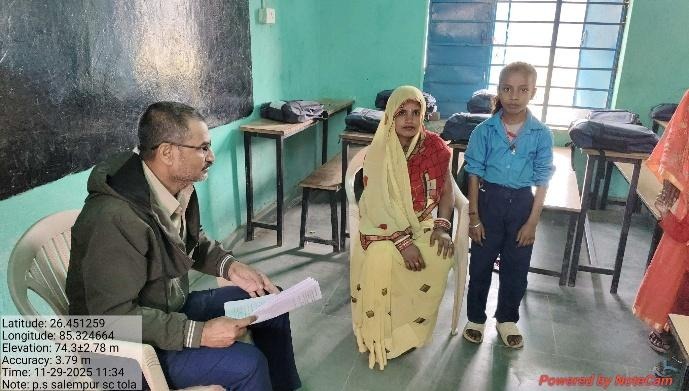
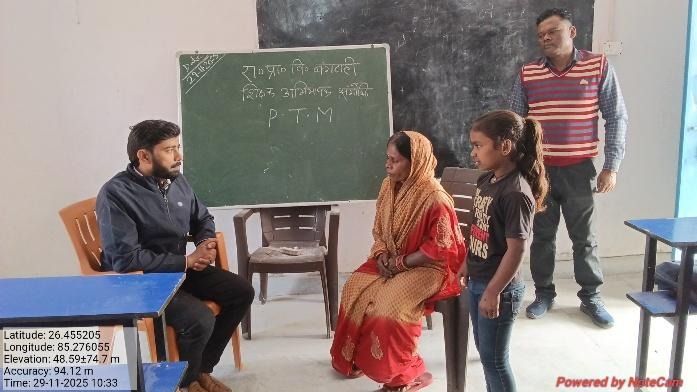
During a routine Parent-Teacher Meeting at Middle School Ashopur in the Sheohar district of Bihar, teachers were discussing the attendance of students with their guardians and parents by going through the attendance register. To begin with, the teacher mentioned the names of the students who were most absent in the current month. On hearing the name of Rakesh from Grade 2 for high absenteeism, his mother became rather alarmed – she shared how he had been coming to school regularly. After a few conversations with fellow students, it was found that Rakesh would leave for school but spend the entire day playing in the field instead, and in the evening, would go back home. Rakesh’s mother noted this and requested to be informed any time he was not attending school, and since then, Rakesh’s attendance has seen a significant improvement.
This incident stayed with me because it captured, in a simple way, what a Parent–Teacher Meeting can achieve. The school knew that the child was frequently absent. His mother believed that he attended school every day. Both cared about the child, yet neither had the complete picture. It took one conversation to connect the two.
This led to one of my strongest reflections from working on the ground: schools and parents often work towards the same goal, but not always together. A structured PTM can create space where information is shared, assumptions are corrected, and collective action becomes possible – all for the benefit of the learners.
Over the last three years (starting 2023), Central Square Foundation has been working alongside the Department of Education in Sheohar to support the implementation of the NIPUN Bihar Mission and strengthen foundational learning across the district. Most of our work naturally focused on improving what happens inside classrooms. But our experience with PTMs reinforced an equally important lesson: a child’s learning journey does not begin and end at the school gate.

From Not Knowing to Knowing
When the DPMU team in Sheohar started focusing on PTMs, one of the first challenges was that the district administration did not have a clear picture of how many schools were actually conducting them.
In the previous academic year [2025-26], we found that only 52% of schools were conducting the PTM and reporting to the state. This is how a systemic gap was identified. We communicated these challenges to the District Education Officer (DEO) and District Programme Officer (DPO-SSA) and suggested that the PTM data across the district be collected, tracked, and monitored. Further, each month, the DEO issued the so-cause letter to the school that did not organise the PTM. These steps helped us to build strong salience, and DEO started to review the PTM at the district.
When more than 90% of schools had started to conduct PTMs, we focused on parental participation and took different steps to increase parental involvement.
- Schools used an invitation card to inform parents about the PTM
- Ensure the class-wise PTM provides one-on-one feedback
- The class teacher started to discuss the children’s progress with their parents
- School followed the PTM schedule calendar, and the district informed them in advance of the agenda
This marked an important transition — from ensuring that an event takes place to thinking more deeply about the purpose it was meant to serve.
From Tracking an Event to Understanding Participation
As the PTMs became more structured and regular, the question was no longer simply, “Was the PTM conducted?” The conversation gradually evolved to, “Who participated, and what happened when they came?”
The DPMU team actively collected data from June 2025 to March 2026 – and it revealed encouraging progress alongside areas requiring focused improvement.
- Each month, an average of 90% of schools report PTM data, reflecting strong compliance and departmental ownership among stakeholders.
- Across FLN Grades 1 to 3, parental participation averaged approximately 32% of students’ attendance on the same day and 21% of enrollment.
- For Grades 1 to 5, overall parental participation averaged 32%, compared with students’ attendance.
- Student attendance during the PTM period ranged from 65% to 70%, which directly influences parent turnout. Certain blocks demonstrated parental participation levels exceeding 35%, indicating that higher engagement is achievable within the current system.
These findings suggest that while reporting mechanisms are functioning effectively, there remains a significant opportunity to deepen parental engagement.


From Attendance to Meaningful Conversations
Over time, it was realised that a well-attended PTM is not necessarily an effective PTM. A parent can attend a meeting without having a meaningful conversation about their child. This shifted our attention from counting participation to examining the quality of engagement.
Cut to 2026 – PTMs are consistently being conducted across the Sheohar district, the data also indicates and verifies it. Now, we are focusing on qualitative discussion and knowledge sharing with parents. The class teacher asks the parents about their children’s attendance this month, and various field observations conducted by our team suggest that PTMs are gradually shifting from general interactions to more focused conversations on key areas including: Student learning progress, Attendance patterns, Classroom participation and Academic support at home, etc. Such shifts are essential to transform PTMs from procedural gatherings into impactful academic improvement for children’s learning.
Leveraging Data for Continuous Improvement
With frequency and discussion agenda being streamlined, the next area of focus was examining the data. Through the PTM dashboard, the DPMU team, along with the district administration, tracked month-on-month progress in parental engagement. High-performing blocks were identified and cross-block learnings were shared, while a list of low-performing blocks and suggested interventions was prepared. Each month, the district administration encourages schools to have evidence-based discussions in the PTM. By analysing parental participation in relation to both enrolment and student attendance, we were better positioned to understand patterns and identify constraints affecting parental involvement. This experience reinforced another important learning: data becomes valuable only when it leads to questions, conversations, and action.
Reflections: What Three Years of This Journey Taught Me
As I look back on my journey in Sheohar, the evolution of the PTM workstream reflects a broader lesson I learned about working with government education systems.
Sustainable change rarely begins with a sophisticated intervention. Sometimes, it begins with making an existing process visible, creating a mechanism to review it consistently, and then using the evidence to ask better questions.
The DPMU journey from 2023-2026 showed us, among many other learnings, that strengthening parental engagement requires sustained attention. Going forward, the system will need to continue reviewing block-wise performance, supporting teachers to conduct class-wise focused PTMs, engaging the parents of students with high absenteeism, and ensuring consistent follow-up.
The long-term opportunity in Sheohar is to establish PTMs as a strategic platform where teachers and parents can regularly discuss a child’s learning, attendance, participation, and progress.
Keywords
Authored by

Nitish Chaurasia
Senior Project Manager, Foundational Learning, Bihar , Central Square Foundation
Share this on