


 Go Back
Share
The Best Policy Conversations Begin in Classrooms: How a learning gap in Basti became a catalyst for change in the state
By Kritagya Kriti
Oct 15, 2026
How can classroom-level insights shape state-wide education priorities? Drawing on CSF’s work with the district administration in Basti, Uttar Pradesh, this blog explores how evidence from student assessments and classroom experiences can inform policy conversations, strengthen academic support and help children catch up on foundational learning.
Over the past decade, Uttar Pradesh has made substantial gains in early-grade learning. ASER (Rural) 2024 data show that since 2018 Grade 3 learning outcomes in the state have improved by 15.6 percentage points in Literacy and 20.6 percentage points in Numeracy.
Those gains have also changed the questions the education system is asking of itself. Uttar Pradesh runs one of the largest school systems in the world with over 1.7 crore children and 5.8 Lakh teachers in about 1.3 Lakh schools. At that scale, administrative execution will always matter. Textbooks have to reach schools, teachers have to be trained, assessments have to run on time and programmes have to be reviewed. But under the NIPUN Bharat Mission, another set of questions is increasingly entering these conversations: What are children actually learning? Where are they struggling? What are teachers seeing in classrooms? And what would help them respond to learning challenges amongst students?
It is in this space that CSF’s work with the district administration sits. The Central Square Foundation’s 10-member District Programme Management Unit (DPMU) in Basti brings together young people with backgrounds in policy, governance and academics to work alongside the education system to strengthen implementation, improve governance and build systems that can respond to what is happening in classrooms. Much of our work is to stay close to implementation: looking at assessment data, visiting schools, listening to teachers and translating what we learn from classrooms into questions that district and state leaders can act on.

I saw this play out during a visit by the senior leadership of the Basic Education Department of Uttar Pradesh, to Basti on 5 May 2026.
The senior official was already closely familiar with the NIPUN Bharat Mission, so for nearly 90 minutes, we discussed how children were learning, what Basti’s data was telling us, where teachers needed support, how instructional leadership could improve and how information from classrooms could travel more effectively through the system.
Then we came to student learning outcomes. One competency caught his attention: Independent Writing.
Basti DPMU’s End-of-Year assessment for Academic Year 2025 showed that 60 per cent of Grade 2 students in Basti had scored zero in Independent Writing. The number was stark and the conversation did not stop at the number.
We discussed how writing asks a great deal of a young child. A child has to understand an idea, find the words for it, organise those words and express them independently. Difficulty with writing can therefore point to gaps across several foundational literacy skills at once.
The senior official kept returning to one phrase: children needed a chance to “catch up” on competencies they had missed before the gap widened.
That shifted the conversation from identifying a problem to thinking differently about the beginning of the school year.
Children enter a new grade at very different levels of readiness. Some carry unfinished learning from the previous year. If teaching moves ahead without addressing those gaps, the distance between what a child knows and what the curriculum expects can grow quickly. We discussed the first few weeks of the academic year as a window to address this.
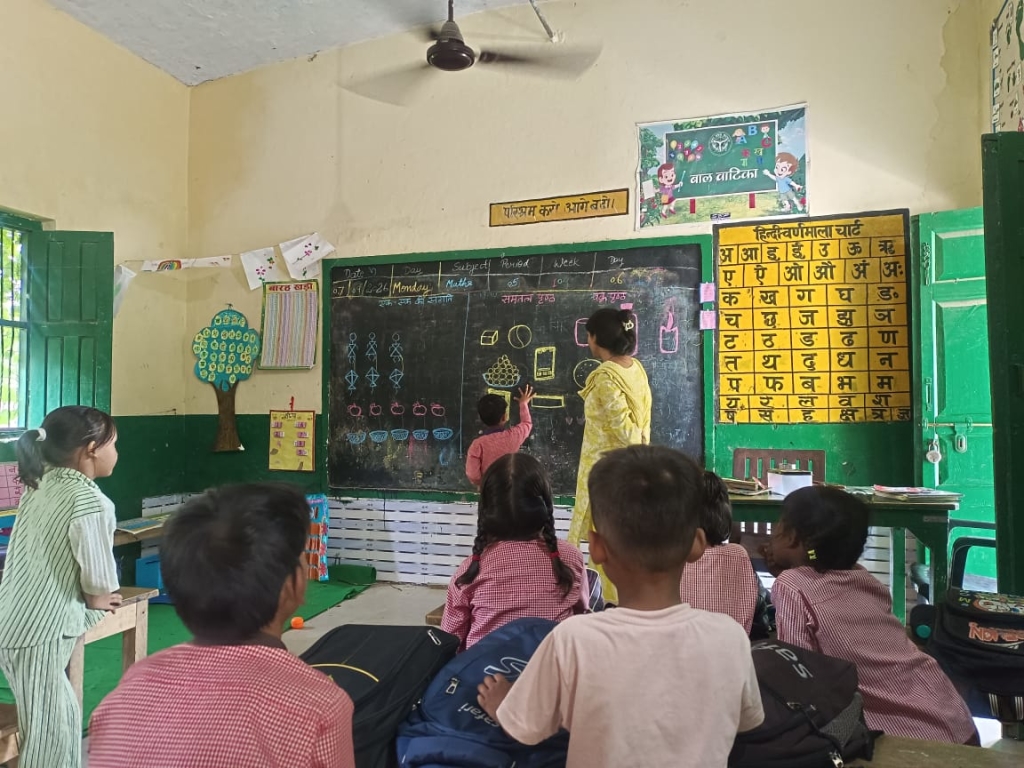
Five weeks later, on 12 June, the state issued detailed directions on Catch-up Shikshan.
The order prescribed a 15-day revision period in July, followed by regular 20 to 30 minute Catch-up sessions based on formative assessment. Teachers were asked to reteach where necessary, move from simpler tasks to more complex ones, analyse children’s errors, model tasks before moving children towards independent practice, and use peer learning and activity-based approaches. It also called for individual student progress to be tracked and Catch-up implementation to be reviewed through existing academic support structures.
The catch-up sessions already build on top of the Teacher Guide design and remedial support for students that teachers are familiar with. The first few weeks, ranging from 4-8 weeks across grades 1-3 are reserved for remedial teaching.
A single district meeting cannot explain a statewide order. Government decisions are shaped by many people, conversations and pieces of evidence. But for those of us who had been in that room, the sequence was hard to miss.
Following the June Catch Up directions, we began working more deliberately with teachers and ARPs in Basti to identify children at risk of falling further behind, understand their specific learning gaps and think through how those gaps could be bridged. This became a continuing part of our work with schools over the following months. By September, we were seeing encouraging signs in classrooms, with children beginning to take on competencies that had previously been difficult for them. While we do not yet have district-wide data to quantify the change, the early signs suggested that children were beginning to catch up.
In Basti, a difficult learning outcome had prompted a very specific question: how do we give children a chance to catch up before they fall further behind?
A few weeks later, that question had become part of the state’s academic instructions to every district.
The rest of the conversation with the Senior Official in Basti followed a similar pattern.
We spoke about Multi-Grade Multi-Level classrooms, where teachers often work with children at different learning levels and, in some cases, across multiple grades in the same room. We discussed how the current teacher guides are designed for single-grade classrooms, making them difficult to use in these settings.
We shared experiences from the field and discussed MGML approaches being tried in Madhya Pradesh, Haryana and Tamil Nadu. The conversation was less about prescribing a pedagogical ideal and more about whether teacher-support materials could reflect the classroom a teacher actually faces.
We had a similar discussion about teacher feedback.
The education system already generates a large amount of information through assessments, reviews and monitoring processes. But teachers hold another kind of information. They know where a tool becomes difficult to use, which part of a lesson works with children and where support breaks down.
The Senior Official pushed us to think about how the system could hear from teachers more regularly, including through technology-enabled mechanisms.
The afternoon moved back and forth between district evidence and questions about how the larger system could respond. The CDO, BSA and DC NIPUN in Basti spoke candidly about what they were seeing. A score on Independent Writing led to a conversation about unfinished learning. Experience from MGML classrooms led to questions about instructional support. Teacher feedback raised questions about how information should travel upwards.
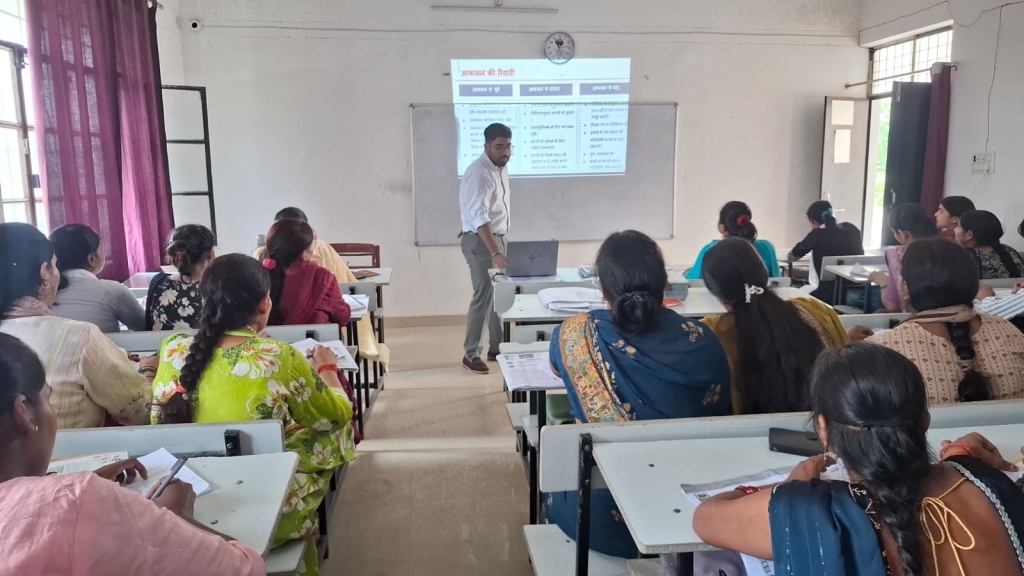
For a young team working at the district level, that movement matters. Much of our work happens close to the ground: looking at assessment patterns, sitting with teachers, observing classrooms and trying to understand why an intervention is or is not working. We often have information that is specific, messy and local. It can be difficult to know whether any of it will travel beyond the district.
The Basti experience made something visible to me. Young professionals working alongside the government may not be the people making the final decision. But we can bring questions into the room that might otherwise remain local. We can put field evidence in front of people with the authority to act on it. And when there is openness on both sides, a district observation can become the starting point for a much larger conversation.
That is what stayed with me after the meeting. On 5 May, we were sitting around a table in Basti discussing why so many Grade 2 children were struggling with Independent Writing and how they might “catch up”. On 12 June, Catch-up Shikshan was part of the state’s academic instructions to every district. The distance between a classroom problem and a state agenda can sometimes be shorter than it looks.
Keywords
Authored by

Kritagya Kriti
Senior Project Manager, Foundational Learning, Central Square Foundation
Share this on